English
 Español
 tiếng việt
 русский
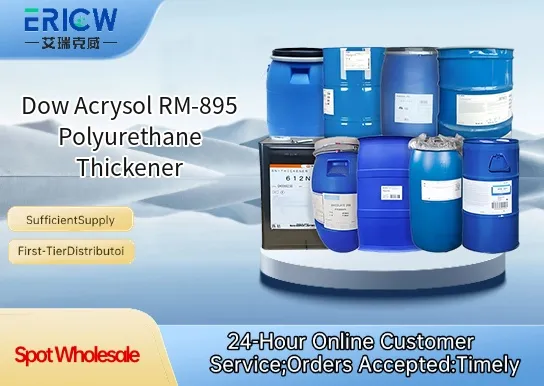
Non-ionic, hydrophobically modified polyurethane (HEUR) rheology modifier for robust viscosity control.
Delivers excellent sag resistance and leveling in waterborne coatings without compromising gloss or clarity.
Compatible with a broad range of surfactants, co-thickeners, and functional additives in architectural and industrial formulations.
Enables low-shear viscosity build and strong high-shear thinning behavior for optimal application performance.
Stable across pH 4–12 and tolerant to moderate levels of electrolytes and freeze-thaw cycling.
Interior and exterior architectural latex paints.
Waterborne wood stains and clear finishes.
Industrial maintenance coatings for metal and concrete substrates.
Textile printing pastes requiring shear-thinning flow and screen stability.
Adhesives and sealants where controlled rheology and open time are critical.
| Chemical Type | Hydrophobically Modified Polyurethane (HEUR) |
| Product Form | Clear to slightly hazy liquid |
| Appearance | Off-white to pale yellow viscous liquid |
| pH (1% aqueous solution) | 6.0 – 8.0 |
| Active Content (wt%) | 30.0 ± 1.0% |
| Viscosity (Brookfield, Spindle #3, 20 rpm, 25°C) | 15,000 – 35,000 cP |
| Primary Applications | Architectural coatings, industrial waterborne coatings, wood finishes |
| Key Features | Non-ionic, high efficiency, low VOC contribution, excellent compatibility |
Q1: What type of rheology does RM-895 provide in waterborne coatings?
A: RM-895 is a non-ionic, hydrophobically modified polyurethane (HEUR) thickener that delivers strong pseudoplastic flow behavior—providing excellent sag resistance while maintaining good leveling and brush/roll application properties.
Q2: Is RM-895 compatible with high-shear pigment dispersions and common co-thickeners?
A: Yes—RM-895 exhibits broad compatibility with typical waterborne architectural and industrial coating systems, including those containing acrylic or associative thickeners. It performs well in formulations with high-shear dispersed pigments and is often used in combination with cellulosic or acrylic thickeners to fine-tune rheological profiles.
Q3: How should RM-895 be incorporated into a formulation for optimal performance?
A: RM-895 is typically added post-emulsification, either neat or pre-diluted in water or glycol ether solvents. To ensure uniform dispersion and avoid localized over-thickening, it is recommended to add gradually under moderate agitation and allow sufficient time for full hydration and network development—usually 15–30 minutes depending on formulation complexity and temperature.
Q4: Does RM-895 offer good freeze-thaw stability in formulated systems?
A: RM-895 contributes to improved freeze-thaw stability when properly integrated into robust formulations. Its non-ionic nature avoids salt sensitivity issues common with some ionic thickeners, though overall system stability depends on the full binder/pigment/additive package—and testing under intended storage conditions is recommended.
Contact With Us:
E-mail: wangxingqiang@ericwchem.com
Have a Questions? Call Us:
Add:
Building A1, Jiete Industrial Park, Huangpu District, Guangzhou City, Guangdong Province, China