English
 Español
 tiếng việt
 русский
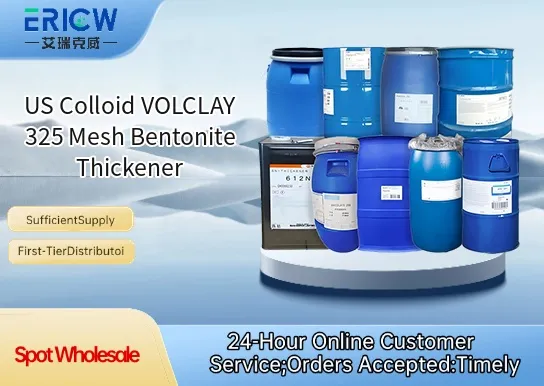
High-yield sodium bentonite with exceptional swelling capacity in water.
Consistent 325-mesh particle size distribution for optimal suspension stability.
Natural rheology modifier—improves viscosity and thixotropy without synthetic additives.
Low heavy metal content and compliant with industrial-grade purity standards.
Excellent gel strength development at low dosages (0.5–2.0 wt%).
Water-based drilling muds for oil & gas and geotechnical applications.
Stabilizer in pigment dispersions for architectural and industrial coatings.
Viscosity enhancer in non-aqueous and aqueous adhesive formulations.
Gelling agent in agricultural suspension concentrates (SC) and pesticide formulations.
Carrier and suspending aid in foundry sand binders and refractory coatings.
| Chemical Type | Sodium bentonite clay |
| Product Form | Fine white to light tan powder |
| Appearance | Free-flowing, dry granular powder |
| Particle Size (95% passing) | 325 mesh (≤44 µm) |
| Moisture Content (max) | 10.0 wt% |
| Loss on Ignition (LOI) | 12–16 wt% |
| Specific Gravity | 2.3–2.5 g/cm³ |
| pH (1% slurry) | 8.5–10.0 |
Q1: What is the primary function of VOLCLAY 325 Mesh in formulations?
A: VOLCLAY 325 Mesh functions as a rheology modifier and suspension agent, providing yield stress, thixotropic behavior, and enhanced particle stabilization in water-based systems.
Q2: How does the 325 mesh specification impact performance?
A: The 325 mesh designation indicates a fine particle size distribution, which contributes to faster hydration, improved dispersion efficiency, and more consistent thickening response compared to coarser bentonites.
Q3: Is VOLCLAY 325 Mesh suitable for high-salinity or low-pH systems?
A: Performance may be reduced in highly saline or strongly acidic environments due to potential clay platelet aggregation or diminished swelling capacity; formulation testing under actual use conditions is recommended.
Q4: What are typical dosage ranges for effective thickening?
A: Dosage depends on formulation requirements but generally ranges from 0.1% to 2% by weight in aqueous systems, with optimal levels determined through bench-scale rheological evaluation.
Q5: Does VOLCLAY 325 Mesh require activation or pretreatment before use?
A: While not strictly required, pre-hydration—such as slow addition with high-shear mixing or slurry preparation—helps maximize dispersion and avoid agglomeration in final formulations.
Contact With Us:
E-mail: wangxingqiang@ericwchem.com
Have a Questions? Call Us:
Add:
Building A1, Jiete Industrial Park, Huangpu District, Guangzhou City, Guangdong Province, China