English
 Español
 tiếng việt
 русский
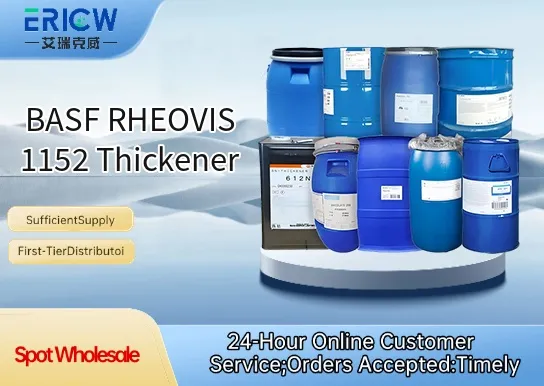
High-efficiency associative thickener based on hydrophobically modified ethoxylated urethane (HEUR) chemistry.
Delivers excellent rheology control with strong pseudoplasticity and outstanding sag resistance in waterborne systems.
Compatible with a broad range of anionic, nonionic, and zwitterionic surfactants, as well as common co-solvents and biocides.
Enables low-odor, low-VOC formulations without compromising viscosity stability or freeze-thaw performance.
Easy incorporation via post-addition; requires no neutralization or pH adjustment for activation.
Architectural paints (interior and exterior latex paints).
Industrial maintenance coatings and coil coatings.
Water-based wood finishes and varnishes.
Printing inks and functional coatings for packaging.
Construction adhesives and tile grouts.
| Chemical Type | Hydrophobically Modified Ethoxylated Urethane (HEUR) |
| Product Form | Liquid concentrate |
| Appearance | Clear to slightly hazy, colorless to pale yellow liquid |
| pH (1% aqueous solution) | 6.5–8.0 |
| Solids Content (wt %) | 35–40% |
| Density (20 °C) | 1.02–1.06 g/cm³ |
| Viscosity (Brookfield DV-II+ @ 20 rpm, 25 °C) | 500–2,500 mPa·s |
| Primary Applications | Waterborne architectural and industrial coatings |
Q1: What is BASF RHEOVIS 1152 Thickener and how does it function in formulations?
A: RHEOVIS 1152 is a hydrophobically modified ethoxylated urethane (HEUR) associative thickener designed to provide efficient rheology control in water-based systems. It functions by forming transient physical networks between hydrophobic end groups and surfactants or polymer particles, delivering pronounced shear-thinning behavior and excellent sag resistance without significantly increasing low-shear viscosity.
Q2: In which types of coatings and applications is RHEOVIS 1152 most commonly used?
A: It is widely employed in architectural interior and exterior paints, especially where high gloss retention, spatter resistance, and brush/roller application performance are critical. It is also suitable for industrial maintenance coatings and some water-based wood finishes where balanced flow and leveling with good film build are required.
Q3: How should RHEOVIS 1152 be incorporated into a formulation?
A: It is typically added during the let-down stage, after pigments and primary thickeners (e.g., cellulosics or clays), under moderate agitation. Pre-dilution with water or compatible co-solvent is recommended to ensure uniform dispersion. Avoid high-shear mixing once fully dispersed to prevent premature network breakdown.
Q4: Is RHEOVIS 1152 compatible with other rheology modifiers and common paint additives?
A: Yes, it exhibits good compatibility with non-ionic surfactants, many defoamers, biocides, and co-thickeners such as HEC or associative alkali-swellable emulsions (ASE). However, interactions with highly anionic dispersants or strong electrolytes may reduce efficiency, so compatibility testing in the final formulation is advised.
Q5: What are key handling and storage considerations for RHEOVIS 1152?
A: Store in original sealed containers at temperatures between 5 °C and 30 °C, protected from freezing and direct sunlight. Prolonged exposure to temperatures above 40 °C may affect viscosity and performance. Ensure adequate ventilation during handling, and refer to the Safety Data Sheet (SDS) for occupational health and safety guidance.
Contact With Us:
E-mail: wangxingqiang@ericwchem.com
Have a Questions? Call Us:
Add:
Building A1, Jiete Industrial Park, Huangpu District, Guangzhou City, Guangdong Province, China