English
 Español
 tiếng việt
 русский
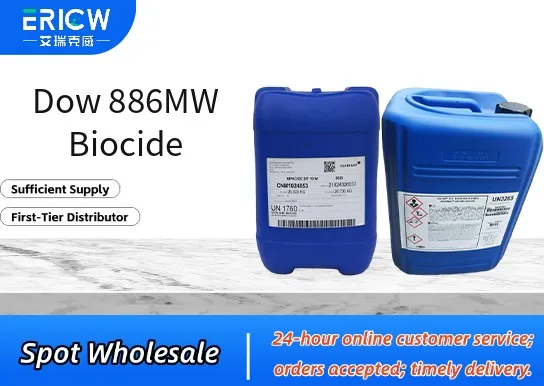
Broad-spectrum efficacy against bacteria, fungi, and algae in industrial water systems.
Stable performance across a wide pH range (5.0–9.5) and tolerant to common water treatment additives.
Low-foaming formulation suitable for high-shear and recirculating cooling water applications.
Compatible with oxidizing biocides for synergistic control in hybrid treatment programs.
Non-volatile and low volatility profile supports safe handling and reduced atmospheric emissions.
Cooling water systems in power generation and HVAC installations.
Process water circuits in petrochemical and refining facilities.
Recirculating water used in paper mill white water systems.
Industrial closed-loop systems requiring non-oxidizing microbial control.
Make-up water treatment in large-scale manufacturing plants.
| Chemical Type | Heterocyclic nitrogen compound (isothiazolinone derivative) |
| Product Form | Liquid concentrate |
| Appearance | Clear, pale yellow to amber liquid |
| pH (1% aqueous solution) | 3.5–5.0 |
| Density (25°C) | 1.08–1.12 g/cm³ |
| Solubility in Water | Completely miscible |
| Primary Applications | Non-oxidizing biocide for industrial water treatment |
| Key Features | Broad-spectrum, low-foaming, oxidation-stable, compatible with common scale/corrosion inhibitors |
Q1: What is the primary mode of action for Dow 886MW Biocide?
A: Dow 886MW Biocide functions primarily as a broad-spectrum antimicrobial agent through membrane disruption and interference with essential cellular processes in bacteria, fungi, and algae. Its efficacy is attributed to its ability to penetrate microbial cell walls and inhibit key metabolic functions.
Q2: In which types of industrial formulations is Dow 886MW Biocide commonly used?
A: It is widely incorporated into water-based industrial products such as metalworking fluids, latex paints, adhesives, caulks, and construction sealants—particularly where long-term preservation against microbial spoilage is required during storage and in-service use.
Q3: Is Dow 886MW Biocide compatible with common formulation ingredients like surfactants and thickeners?
A: Yes, Dow 886MW Biocide demonstrates good compatibility with many anionic, nonionic, and amphoteric surfactants, as well as common rheology modifiers including associative thickeners and cellulose derivatives—though compatibility testing under actual formulation conditions is recommended.
Q4: How should Dow 886MW Biocide be added to a formulation?
A: It is typically added during the cool-down phase of manufacturing, after high-temperature processing steps, to preserve biocidal activity. Dosage depends on formulation requirements but generally ranges from 0.1% to 2% by weight, with optimal levels determined through challenge testing and stability assessment.
Q5: Does Dow 886MW Biocide require pH adjustment for optimal performance?
A: Performance is generally stable across a broad pH range (approximately 4–10), though maximum efficacy is often observed in mildly acidic to neutral conditions. Significant deviation outside this range may affect stability or antimicrobial activity, so pH monitoring during formulation is advisable.
Contact With Us:
E-mail: wangxingqiang@ericwchem.com
Have a Questions? Call Us:
Add:
Building A1, Jiete Industrial Park, Huangpu District, Guangzhou City, Guangdong Province, China