English
 Español
 tiếng việt
 русский
High thermal stability with continuous use temperature up to 150 °C.
Excellent UV resistance and long-term color retention in outdoor exposure.
Low viscosity for easy processing and uniform film formation in coating applications.
Crosslinkable via amino resins or melamine-formaldehyde systems for enhanced hardness and chemical resistance.
Low VOC formulation compliant with stringent environmental regulations including EPA and EU REACH.
Automotive OEM clearcoats and topcoats for exterior body panels.
Industrial coil coatings for pre-painted metal roofing and cladding.
Appliance finishes requiring scratch resistance and gloss retention.
General-purpose high-performance industrial baking enamels.
Architectural metal coatings exposed to harsh weathering conditions.
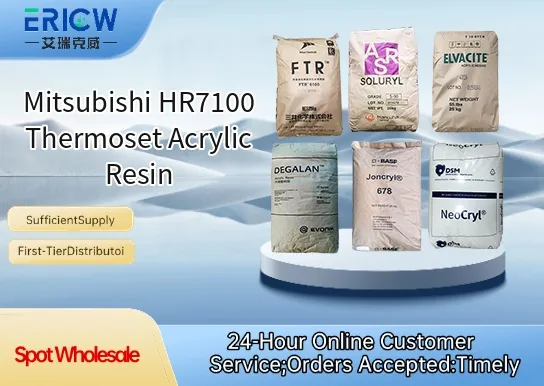
| Chemical Type | Thermosetting acrylic copolymer |
| Product Form | Liquid, solvent-based solution |
| Appearance | Clear, pale yellow to colorless liquid |
| Solvent System | Xylene/toluene/butyl acetate blend |
| Non-Volatile Content (wt%) | 55–60% (at 120 °C, 60 min) |
| Acid Value (mg KOH/g) | 8–12 |
| Viscosity (mPa·s, 25 °C) | 4,000–6,000 (Brookfield, #3 spindle, 6 rpm) |
| Hydroxyl Value (mg KOH/g) | 95–105 |
Q1: What are the primary curing mechanisms for HR7100, and what types of crosslinkers is it compatible with?
A: HR7100 is a hydroxyl-functional thermoset acrylic resin designed for catalyzed condensation curing. It exhibits excellent reactivity with common amino resins (e.g., melamine-formaldehyde and urea-formaldehyde), as well as isocyanate-based crosslinkers. Cure profiles are typically optimized under conventional thermal conditions (120–160 °C), and catalyst selection (e.g., acid catalysts) should be aligned with the chosen crosslinker system and substrate requirements.
Q2: How does HR7100 perform in high-gloss, weather-resistant topcoat applications?
A: HR7100 delivers outstanding clarity, gloss retention, and UV stability due to its highly branched acrylic architecture and low aromatic content. It is widely used in premium automotive and industrial topcoats where long-term color stability, resistance to chalking, and surface hardness are critical. Performance is further enhanced when formulated with appropriate UV absorbers and HALS stabilizers.
Q3: Is HR7100 suitable for low-VOC or solvent-reduced coating systems?
A: Yes — HR7100 offers good solubility in common mid-polarity solvents (e.g., esters, ketones, glycol ethers) and can be formulated into solvent-borne systems with VOC levels significantly below traditional high-solids benchmarks. Its molecular design supports efficient film formation at reduced solvent demand, making it adaptable for compliant industrial coatings targeting regional VOC regulations.
Q4: What substrate adhesion characteristics can be expected with HR7100-based coatings?
A: HR7100 provides strong adhesion to a broad range of substrates including cold-rolled steel, aluminum, galvanized metal, and properly prepared plastics. Adhesion performance is further improved through standard pretreatment methods (e.g., phosphating, chromating, or plasma activation) and optimized formulation with compatible adhesion promoters.
Contact With Us:
E-mail: wangxingqiang@ericwchem.com
Have a Questions? Call Us:
Add:
Building A1, Jiete Industrial Park, Huangpu District, Guangzhou City, Guangdong Province, China