English
 Español
 tiếng việt
 русский
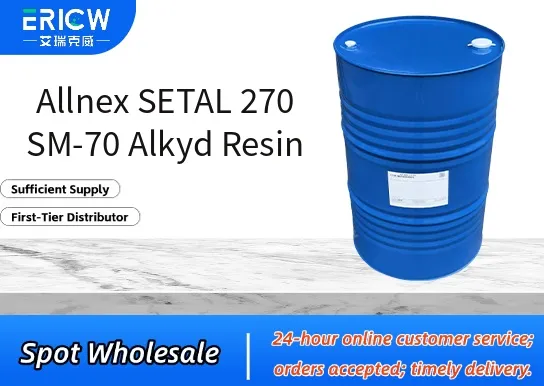
Medium-oil-length alkyd resin based on phthalic anhydride and glycerol, offering balanced drying and flexibility.
Designed for solvent-borne industrial coatings with excellent gloss retention and film clarity.
Provides good compatibility with nitrocellulose, acrylics, and other common coating resins.
Delivers robust adhesion to metal substrates and wood surfaces under ambient cure conditions.
Formulated for low volatile organic compound (VOC) compliance in standard solvent-based systems.
Industrial maintenance coatings for metal structures and equipment.
General-purpose air-dry enamels for metal furniture and appliances.
Wood finishing coatings including varnishes and clear topcoats.
Undercoat and primer formulations requiring good sandability and overcoat adhesion.
Marine and agricultural equipment coatings requiring weather resistance and mechanical durability.
| Chemical Type | Phthalic–glycerol alkyd resin |
| Product Form | Liquid |
| Appearance | Clear to pale yellow viscous liquid |
| Primary Applications | Industrial maintenance coatings, general-purpose enamels, wood finishes |
| Key Features | Medium oil length, ambient cure, good compatibility, gloss retention |
| Benefits | Easy formulation, reliable film formation, substrate versatility |
| Solubility | Soluble in aromatic hydrocarbons, ketones, and esters |
| Storage Stability | Stable at room temperature for ≥12 months in sealed containers |
Q1: What is the primary application area for SETAL 270 SM-70?
A: SETAL 270 SM-70 is a medium-oil, soya-oil-based alkyd resin designed primarily for solvent-borne decorative and industrial maintenance coatings, including primers, undercoats, and mid-coats where balanced drying performance, gloss retention, and substrate adhesion are required.
Q2: Is SETAL 270 SM-70 suitable for air-drying systems?
A: Yes — it is formulated for oxidative crosslinking and performs well in ambient-cure systems. It offers good through-dry and surface dry balance, making it appropriate for air-drying applications without forced curing, though drying time may vary with film thickness, humidity, and ambient temperature.
Q3: How does SETAL 270 SM-70 compare to long-oil alkyds in terms of flexibility and hardness development?
A: As a medium-oil alkyd, SETAL 270 SM-70 provides a more balanced profile than long-oil variants — offering higher hardness and better chemical resistance while retaining sufficient flexibility for substrates prone to thermal or mechanical stress, such as metal and wood.
Q4: Can SETAL 270 SM-70 be used in combination with other resins or crosslinkers?
A: Yes — it exhibits good compatibility with common coating resins such as melamine-formaldehyde, urea-formaldehyde, and certain acrylics. It can also be modified or co-reacted in hybrid systems to enhance performance attributes like block resistance or recoatability, subject to compatibility testing.
Q5: What solvents are typically recommended for diluting SETAL 270 SM-70?
A: It is readily soluble in standard aromatic and aliphatic hydrocarbon solvents, including xylene, Solvesso™ 100, and high-flash naphthas. Ketones and esters may also be used depending on formulation requirements, but compatibility and evaporation rate should be evaluated during development.
Contact With Us:
E-mail: wangxingqiang@ericwchem.com
Have a Questions? Call Us:
Add:
Building A1, Jiete Industrial Park, Huangpu District, Guangzhou City, Guangdong Province, China