English
 Español
 tiếng việt
 русский
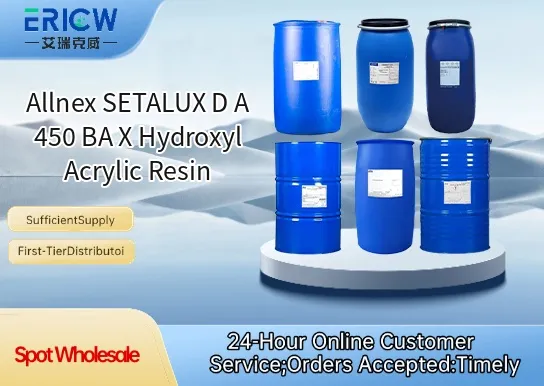
High hydroxyl functionality for excellent crosslink density with melamine and polyisocyanate curing agents.
Low VOC formulation compliant with stringent environmental regulations for industrial coatings.
Superior weatherability and UV resistance, enabling long-term gloss and color retention.
Excellent compatibility with common solvent-based acrylics, alkyds, and polyester resins.
Good flow and leveling characteristics for high-gloss, defect-free film formation.
Automotive OEM topcoats and clearcoats.
Industrial maintenance coatings for metal substrates.
General-purpose coil coatings requiring durability and aesthetics.
High-performance appliance finishes.
Powder coating hybrid systems (liquid primers or flow-coat modifiers).
| Chemical Type | Hydroxyl-functional acrylic copolymer |
| Product Form | Liquid resin solution |
| Appearance | Clear, pale yellow liquid |
| Solvent System | Aromatic-free (typically xylene/ethyl acetate blend) |
| Hydroxyl Value (mg KOH/g) | 42–48 |
| Acid Value (mg KOH/g) | < 5 |
| Non-Volatile Content (% w/w) | 50 ± 2 |
| Viscosity (mPa·s, 25°C, Brookfield RVT Spindle #3 @ 20 rpm) | 1,200–1,800 |
Q1: What is the primary function of SETALUX D A 450 BA X in coating formulations?
A: SETALUX D A 450 BA X is a hydroxyl-functional acrylic resin designed to serve as a reactive binder in two-component polyurethane and melamine-cured systems. It contributes to film formation, hardness development, gloss retention, and chemical resistance while enabling good compatibility with common crosslinkers and solvents.
Q2: Which solvent systems is this resin typically compatible with?
A: SETALUX D A 450 BA X exhibits good solubility in common aromatic and aliphatic hydrocarbon solvents, ketones (e.g., MEK, MIBK), and esters (e.g., butyl acetate). It is generally not recommended for use in high-polarity, water-based, or strongly hydrogen-bonding media without appropriate modification or formulation support.
Q3: How does this resin perform in UV-curable hybrid systems?
A: While SETALUX D A 450 BA X is not inherently UV-reactive, it can be incorporated into hybrid UV/thermal cure systems where it participates in thermal crosslinking (e.g., with melamine or blocked isocyanates) alongside UV-curable acrylates. Its hydroxyl functionality supports co-reactivity, though full optimization requires compatibility testing with photoinitiators and monomers.
Q4: Can this resin be used in low-VOC or high-solids coatings?
A: Yes — its relatively high solids content and favorable viscosity profile make it suitable for high-solids formulations. When combined with low-VOC solvents and optimized crosslinker selection, it supports compliance with evolving regulatory expectations for reduced emissions without sacrificing film performance.
Contact With Us:
E-mail: wangxingqiang@ericwchem.com
Have a Questions? Call Us:
Add:
Building A1, Jiete Industrial Park, Huangpu District, Guangzhou City, Guangdong Province, China