English
 Español
 tiếng việt
 русский
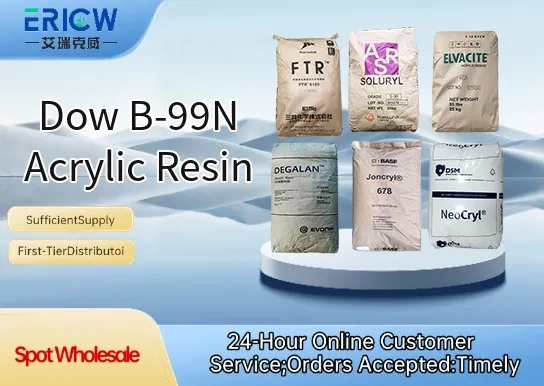
High solids content for improved coating efficiency and reduced VOC emissions.
Excellent UV resistance and long-term color retention in exterior applications.
Good compatibility with common crosslinkers including melamine and polyisocyanate systems.
Low solution viscosity enabling easy handling and high-solids formulation flexibility.
Consistent batch-to-batch performance supported by Dow’s stringent quality control.
Automotive OEM clearcoats and basecoats.
Industrial maintenance coatings for metal substrates.
Architectural high-performance façade coatings.
Plastic coatings requiring mar resistance and gloss stability.
General-purpose high-solids decorative topcoats.
| Chemical Type | Acrylic copolymer |
| Product Form | Liquid resin in organic solvent |
| Appearance | Clear, pale yellow liquid |
| Solids Content (wt%) | 55–60% |
| Acid Value (mg KOH/g) | 8–12 |
| Gardner Color | ≤ 3 |
| Viscosity (Brookfield, #4 spindle, 25°C, cps) | 1,500–3,500 |
| Primary Applications | High-performance thermoset coatings |
Q1: What is the primary function of Dow B-99N in coating and ink formulations?
A: Dow B-99N is a water-dispersible acrylic resin designed primarily as a rheology modifier and film-forming aid. It helps improve pigment suspension stability, enhance gloss development, and support uniform film formation in waterborne architectural coatings, industrial finishes, and packaging inks.
Q2: Is Dow B-99N compatible with common co-binders and additives used in water-based systems?
A: Yes, Dow B-99N demonstrates broad compatibility with typical waterborne resins—including styrene-acrylics, vinyl acetate copolymers, and polyurethane dispersions—as well as common surfactants, defoamers, and biocides. Compatibility testing under actual formulation conditions is recommended to confirm performance synergy.
Q3: How should Dow B-99N be incorporated into a formulation to ensure optimal performance?
A: For best results, Dow B-99N should be added during the let-down stage, after high-shear dispersion of pigments and fillers. It is typically introduced as a pre-diluted aqueous solution (e.g., 10–20% solids) under moderate agitation to avoid localized viscosity spikes or agglomeration.
Q4: Does Dow B-99N contribute to final film properties such as scrub resistance or water sensitivity?
A: Yes—when properly formulated, Dow B-99N supports improved scrub resistance and reduced water sensitivity in dried films due to its ability to promote coalescence and enhance interparticle fusion. Its contribution depends on overall resin balance, coalescent selection, and cure conditions.
Contact With Us:
E-mail: wangxingqiang@ericwchem.com
Have a Questions? Call Us:
Add:
Building A1, Jiete Industrial Park, Huangpu District, Guangzhou City, Guangdong Province, China