English
 Español
 tiếng việt
 русский
High reactivity with standard bisphenol-A and bisphenol-F epoxy resins at ambient and elevated temperatures.
Excellent chemical resistance in cured systems, particularly against alkalis and solvents.
Low viscosity enables easy handling, precise metering, and uniform dispersion in formulated systems.
Provides superior mechanical strength and thermal stability in final cured composites.
Compatible with common accelerators and modifiers for tailored cure profiles and processing windows.
Electrical insulation encapsulants for power electronics and transformers.
Structural adhesives in automotive and aerospace composite bonding.
Protective coatings for industrial flooring and corrosion-resistant linings.
High-performance potting compounds for LED modules and sensor housings.
Wind turbine blade matrix resins requiring extended pot life and rapid post-cure development.
| Chemical Type | Aromatic amine-based curing agent |
| Product Form | Liquid |
| Appearance | Pale yellow to amber transparent liquid |
| Primary Applications | Epoxy resin curing for high-performance composites and encapsulants |
| Key Features | Reactive amine functionality, low volatility, non-crystallizing |
| Benefits | Improved interlaminar shear strength, reduced exotherm, enhanced Tg retention |
| Storage Stability | Stable under nitrogen atmosphere at 5–25°C for ≥12 months |
| Handling Precautions | Use in well-ventilated areas; skin/eye protection recommended per SDS |
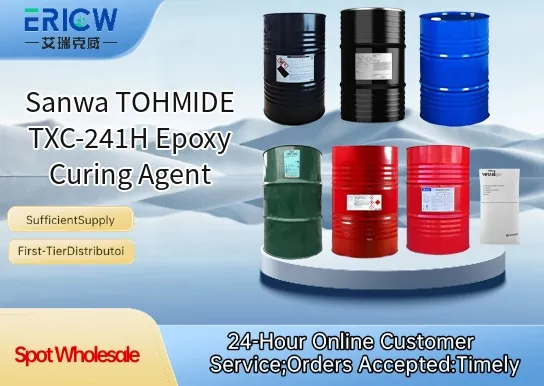
Q1: What is the primary chemical class and functional mechanism of TXC-241H?
A: TXC-241H is a latent, amine-based epoxy curing agent designed for heat-activated crosslinking. It functions through thermal decomposition to release active amine species, enabling controlled cure onset and extended pot life at ambient temperatures.
Q2: How does TXC-241H compare to conventional dicyandiamide (DICY) in terms of processing and performance?
A: Unlike DICY, TXC-241H offers improved solubility in common epoxy resins and reduced dust generation during handling. It typically delivers faster gel times and higher glass transition temperatures (Tg) in cured systems under equivalent thermal profiles, while maintaining good storage stability in formulated one-component systems.
Q3: What is the recommended activation temperature range for full cure?
A: Full reactivity is generally achieved with thermal treatment above 140 °C, with optimal cure profiles typically applied between 150 °C and 180 °C. The exact onset and rate of cure depend on resin type, heating ramp, and formulation additives.
Q4: Is TXC-241H compatible with standard bisphenol-A and bisphenol-F epoxy resins?
A: Yes — TXC-241H demonstrates broad compatibility with conventional liquid and solid epoxy resins, including DGEBA and DGEBF types. It is commonly used in powder coatings, electrical encapsulants, and structural adhesives where low volatility and uniform dispersion are required.
Q5: What safety and handling considerations apply during industrial use?
A: As with all amine-containing curing agents, TXC-241H should be handled using appropriate personal protective equipment (PPE), including gloves and eye protection. It is recommended to avoid prolonged skin contact and ensure adequate ventilation during mixing and processing to minimize inhalation exposure to dust or aerosols.
Contact With Us:
E-mail: wangxingqiang@ericwchem.com
Have a Questions? Call Us:
Add:
Building A1, Jiete Industrial Park, Huangpu District, Guangzhou City, Guangdong Province, China