English
 Español
 tiếng việt
 русский
High reactivity with hydroxyl-terminated polyols for rapid gelation and short demold times.
Excellent compatibility with aromatic and aliphatic polyol systems in solvent-based and solvent-free formulations.
Consistent batch-to-batch performance ensured by strict Mitsui Chemicals quality control protocols.
Low volatility and controlled exotherm profile, supporting safer handling and improved process stability.
Enables production of flexible to semi-rigid polyurethane elastomers with superior mechanical resilience.
Automotive interior components including instrument panel skins and door trim substrates.
Industrial roller covers and precision casting elastomers requiring high abrasion resistance.
Footwear midsoles and outsoles where dynamic rebound and compression set resistance are critical.
Sealants and adhesives for construction and transportation bonding applications.
Coated fabrics and synthetic leather substrates demanding flexibility and surface integrity.
| Chemical Type | TDI-based aromatic polyisocyanate adduct (trimeric) |
| Product Form | Liquid |
| Appearance | Pale yellow to amber transparent liquid |
| NCO Content (wt%) | 12.5 – 13.5% |
| Viscosity at 25°C (mPa·s) | 1,200 – 1,800 |
| Functionality (avg.) | ~3.0 |
| Storage Stability | Stable for ≥12 months at 15–25°C in sealed containers |
| Primary Applications | Polyurethane elastomers, coatings, adhesives, sealants (CASE) |
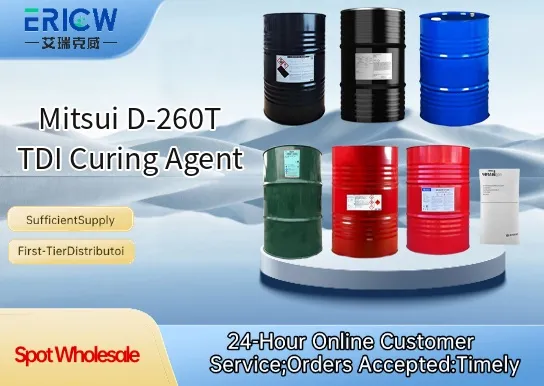
Q1: What is the primary chemical nature of Mitsui D-260T?
A: Mitsui D-260T is a liquid aromatic polyisocyanate-based curing agent derived from toluene diisocyanate (TDI), formulated with controlled functionality and viscosity to support consistent reactivity in two-component polyurethane systems.
Q2: Which types of resin systems is D-260T typically compatible with?
A: D-260T is designed for use with hydroxyl-terminated polyesters, polyethers, acrylics, and certain modified epoxy resins in ambient- or heat-cured PU coatings, adhesives, and sealants—particularly where balanced pot life and film development are required.
Q3: How does D-260T compare to standard TDI prepolymers in terms of handling and safety?
A: As a modified TDI derivative, D-260T exhibits lower vapor pressure and reduced volatility compared to unmodified TDI monomers, contributing to improved workplace handling characteristics—though appropriate engineering controls and PPE remain essential during processing.
Q4: What are key storage and shelf-life considerations for D-260T?
A: Store in tightly sealed containers under dry, cool conditions (below 30 °C) and protected from moisture. When stored properly, typical shelf life is 12 months from date of manufacture; prolonged exposure to humidity or elevated temperatures may affect reactivity and viscosity.
Q5: Is D-260T suitable for applications requiring FDA compliance or food-contact approval?
A: D-260T is not intended for direct food-contact applications and has not been evaluated or certified under FDA, EU Framework Regulation, or similar food-contact legislation. Formulators must conduct full regulatory assessment of the final cured system for any intended end-use.
Contact With Us:
E-mail: wangxingqiang@ericwchem.com
Have a Questions? Call Us:
Add:
Building A1, Jiete Industrial Park, Huangpu District, Guangzhou City, Guangdong Province, China