English
 Español
 tiếng việt
 русский
Excellent film-forming capability with high gloss and clarity.
Superior abrasion and scratch resistance for demanding end uses.
Low VOC content, compliant with stringent environmental regulations.
Good hydrolytic stability and extended shelf life under recommended storage conditions.
Easy dispersion in water and compatibility with common co-solvents and additives.
Waterborne leather finishing topcoats and protective coatings.
High-performance wood coatings for furniture and flooring.
Textile coating binders for durable, flexible fabric finishes.
Industrial maintenance coatings requiring chemical and mechanical resilience.
Automotive interior trim coatings with low odor and high aesthetics.
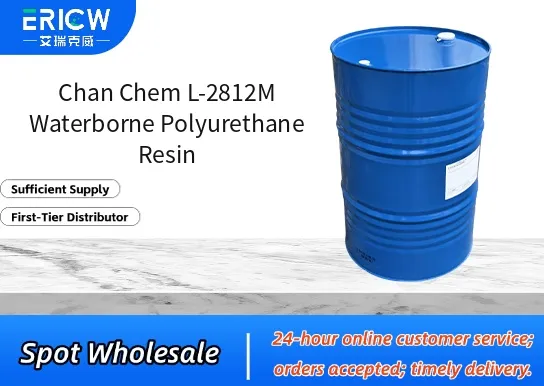
| Chemical Type | Anionic aliphatic polyurethane dispersion |
| Product Form | Aqueous dispersion |
| Appearance | Opaque white to light yellow liquid |
| pH (25°C) | 7.5 – 8.5 |
| Solid Content (wt%) | 28.0 ± 1.0% |
| Viscosity (Brookfield RVT, #2 spindle, 20 rpm, 25°C) | 150 – 400 mPa·s |
| Particle Size (D50) | 80 – 120 nm |
| Minimum Film Formation Temperature (MFFT) | 12 – 16°C |
Q1: What are the primary application areas for L-2812M?
A: L-2812M is commonly used in high-performance waterborne coatings for flexible substrates, including synthetic leather finishing, textile coatings, and soft-touch decorative films. Its balanced film-forming ability and mechanical resilience make it especially suitable for applications requiring abrasion resistance and elasticity.
Q2: How does L-2812M compare to solvent-based polyurethane resins in terms of performance?
A: While L-2812M delivers comparable toughness, flexibility, and adhesion to many solvent-based systems, it eliminates VOC emissions during processing and enables safer handling. Film properties such as gloss retention and chemical resistance are formulation-dependent but generally meet industrial expectations for waterborne alternatives.
Q3: Can L-2812M be blended with other waterborne polymers or additives?
A: Yes, L-2812M exhibits good compatibility with common waterborne acrylics, styrene-acrylic dispersions, and crosslinkers such as aziridine or carbodiimide types. Compatibility should always be verified experimentally in the final formulation due to sensitivity to pH, ionic strength, and surfactant interactions.
Q4: What are the recommended storage conditions and shelf life?
A: Store L-2812M in tightly sealed containers at temperatures between 5 °C and 30 °C, away from freezing and direct sunlight. Under these conditions, the typical unopened shelf life is 6 months. Prior to use, inspect for signs of coagulation or phase separation — if observed, the product should not be used.
Contact With Us:
E-mail: wangxingqiang@ericwchem.com
Have a Questions? Call Us:
Add:
Building A1, Jiete Industrial Park, Huangpu District, Guangzhou City, Guangdong Province, China