English
 Español
 tiếng việt
 русский
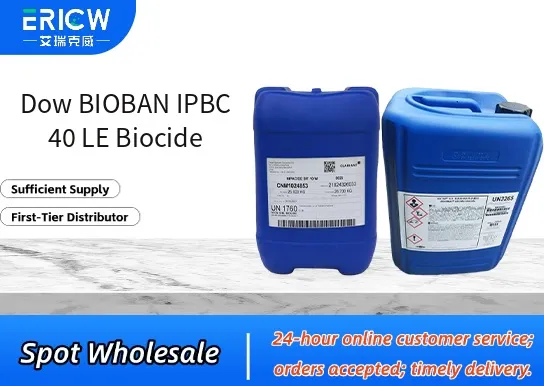
Broad-spectrum antimicrobial efficacy against bacteria, fungi, and algae.
Low-volatility liquid emulsion formulation for enhanced stability and handling safety.
Compatible with a wide range of water-based industrial formulations including paints, coatings, and adhesives.
Regulatory-compliant biocide approved for use in multiple global markets under relevant biocidal product regulations.
Effective at low use concentrations, supporting cost-efficient preservation without compromising performance.
Preservation of architectural and industrial water-based paints and coatings.
Antimicrobial protection in latex-based adhesives and sealants.
Stabilization of aqueous polymer dispersions and emulsions.
Protection of construction chemicals such as grouts, mortars, and tile adhesives.
Preservation of nonwovens and textile finishing baths.
| Chemical Type | Iodopropynyl butylcarbamate (IPBC) |
| Product Form | Stable aqueous emulsion |
| Appearance | Opaque white to off-white liquid |
| Active Ingredient Content | Approx. 40 wt% IPBC |
| pH (1% aqueous solution) | 6.5 – 8.5 |
| Density (20 °C) | 1.02 – 1.06 g/cm³ |
| Solubility | Insoluble in water; forms stable oil-in-water emulsion |
| Storage Stability | ≥12 months at 5–25 °C in original sealed container |
Q1: What is the primary active ingredient in Dow BIOBAN IPBC 40 LE Biocide?
A: The active ingredient is iodopropynyl butylcarbamate (IPBC), formulated as a stable, low-emission liquid concentrate to support consistent performance and handling safety in industrial applications.
Q2: In which types of formulations is Dow BIOBAN IPBC 40 LE Biocide commonly used?
A: It is widely applied in water-based paints, coatings, adhesives, sealants, construction materials, and personal care products where broad-spectrum protection against bacteria, yeasts, and molds is required during storage and in-service life.
Q3: How does the “LE” (Low Emission) designation benefit formulators?
A: The LE formulation is designed to minimize volatile organic compound (VOC) contribution and reduce potential for odor or haze formation, supporting compliance with evolving sustainability and indoor air quality expectations without compromising antimicrobial efficacy.
Q4: Is Dow BIOBAN IPBC 40 LE Biocide compatible with common preservative systems?
A: Yes — it demonstrates good compatibility with many co-biocides and stabilizers used in industrial formulations, though compatibility testing under actual use conditions is recommended to ensure stability and performance synergy.
Q5: What is the typical dosage range for effective preservation?
A: Dosage depends on formulation requirements, challenge level, and regulatory context, but it is typically used at low concentrations — generally ranging from 0.1% to 2% by weight — with optimization determined through challenge testing and real-time stability studies.
Contact With Us:
E-mail: wangxingqiang@ericwchem.com
Have a Questions? Call Us:
Add:
Building A1, Jiete Industrial Park, Huangpu District, Guangzhou City, Guangdong Province, China