English
 Español
 tiếng việt
 русский
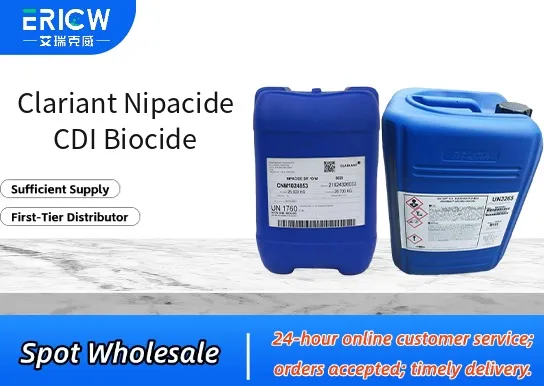
High-efficiency BIT biocide – Effective against G+/G– bacteria, yeast and fungi
Eco-friendly formula – VOC-free & formaldehyde-free, low toxicity
Ultra-wide stability – pH 2–12, temperature stable up to 100℃
FDA compliant – Suitable for food contact applications
Easy to disperse – Good compatibility in all water-based systems
Water-based coatings and decorative paints
Various polymer emulsions & adhesives
Metalworking fluids and cutting fluids
Mineral slurries & calcium carbonate slurries
Concrete additives and water-based building materials
| Brand | Clariant |
| Product Type | BIT-based in-can biocide |
| Form | Aqueous dispersion |
| Active Ingredient | 1,2-Benzisothiazolin-3-one (BIT) |
| Active Content | approx. 20% |
| pH Stability | 2–12 |
| Temperature Stability | ≤100℃ |
| Recommended Dosage | 0.1–0.25% |
Q1: What is the primary active ingredient in Nipacide BIT AS 20?
A: The active ingredient is 1,2-benzisothiazol-3(2H)-one (BIT), supplied as a stable aqueous suspension at 20% active concentration. It functions as a broad-spectrum biocide effective against bacteria, yeasts, and molds.
Q2: In which types of industrial formulations is Nipacide BIT AS 20 commonly used?
A: It is widely applied in water-based industrial products such as metalworking fluids, latex paints and coatings, adhesives, construction chemicals, and cleaning concentrates—where long-term microbial stability is required during storage and use.
Q3: Is Nipacide BIT AS 20 compatible with common formulation components?
A: Yes, it demonstrates good compatibility with anionic, nonionic, and amphoteric surfactants, many thickeners, and typical pH adjusters. Stability is generally maintained across a pH range of approximately 4–10, though performance may vary depending on specific system composition and ionic strength.
Q4: How should Nipacide BIT AS 20 be dosed in a formulation?
A: Dosage depends on formulation requirements, challenge level, and regulatory considerations in the target market. It is typically used at low concentrations, generally ranging from 0.1% to 2% by weight of the final product, with optimal levels determined through preservative efficacy testing (PET) under relevant conditions.
Contact With Us:
E-mail: wangxingqiang@ericwchem.com
Have a Questions? Call Us:
Add:
Building A1, Jiete Industrial Park, Huangpu District, Guangzhou City, Guangdong Province, China