English
 Español
 tiếng việt
 русский
Highly selective for propylene oxide (PO) production via the hydrogen peroxide to propylene oxide (HPPO) process.
Exceptional long-term stability under continuous industrial operation conditions.
Low titanium leaching ensures consistent product quality and reduced downstream purification burden.
Optimized pore structure enhances mass transfer efficiency and catalyst utilization.
Designed for seamless integration into existing HPPO plant infrastructure with minimal retrofit requirements.
Propylene oxide (PO) manufacturing in licensed HPPO technology plants.
Co-production of PO and propylene glycol ethers in integrated petrochemical complexes.
On-purpose PO supply for polyether polyols used in flexible polyurethane foams.
High-purity PO synthesis for electronic-grade and pharmaceutical-intermediate applications.
Sustainable PO production supporting carbon-efficient chemical value chains.
| Chemical Type | Titanium silicalite-1 (TS-1) based zeolitic catalyst |
| Product Form | Free-flowing granular solid |
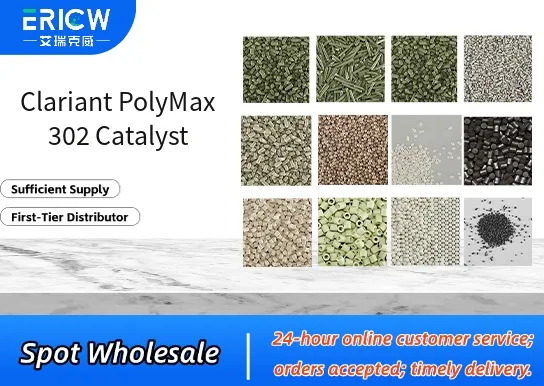
| Appearance | White to off-white cylindrical pellets |
| Primary Application | Hydrogen peroxide to propylene oxide (HPPO) reaction |
| Key Features | High Ti dispersion, hydrophobic surface, narrow particle size distribution |
| Benefits | Improved PO selectivity (>99%), extended cycle life, reduced H₂O₂ decomposition |
| Storage Condition | Room temperature, dry environment, protected from moisture |
| Handling Precaution | Use in well-ventilated areas; avoid inhalation of dust |
Q1: What is the primary function of PolyMax 302 in polyolefin processing?
A: PolyMax 302 is a highly active metallocene-based catalyst designed to enable precise control over polymer microstructure—particularly for producing linear low-density polyethylene (LLDPE) and ethylene copolymers with narrow molecular weight distribution and uniform comonomer incorporation.
Q2: How does PolyMax 302 differ from conventional Ziegler–Natta catalysts?
A: Unlike traditional Ziegler–Natta systems, PolyMax 302 offers single-site activity, resulting in polymers with superior homogeneity, enhanced clarity, improved toughness, and more predictable rheological behavior—especially beneficial for demanding film and injection molding applications.
Q3: Is PolyMax 302 compatible with common supported catalyst systems or reactor configurations?
A: Yes—PolyMax 302 is engineered for compatibility with standard slurry, solution, and gas-phase polyolefin processes. It can be used in both standalone and hybrid catalyst systems, though optimal integration requires coordination with Clariant technical support to align with existing reactor kinetics and activation protocols.
Q4: What are typical handling and storage requirements for this catalyst?
A: PolyMax 302 must be handled under strict inert atmosphere conditions (e.g., nitrogen or argon), protected from moisture, oxygen, and light. Storage is recommended at controlled ambient temperatures in sealed, original packaging; prolonged exposure to ambient air may compromise catalytic activity and selectivity.
Q5: How should dosage be determined for a new formulation?
A: Dosage depends on formulation requirements, target polymer properties, and process conditions. PolyMax 302 is typically used at low concentrations relative to conventional catalysts, and the optimal level is best established through lab-scale screening and pilot trials conducted in collaboration with Clariant’s application development team.
Contact With Us:
E-mail: wangxingqiang@ericwchem.com
Have a Questions? Call Us:
Add:
Building A1, Jiete Industrial Park, Huangpu District, Guangzhou City, Guangdong Province, China