English
 Español
 tiếng việt
 русский
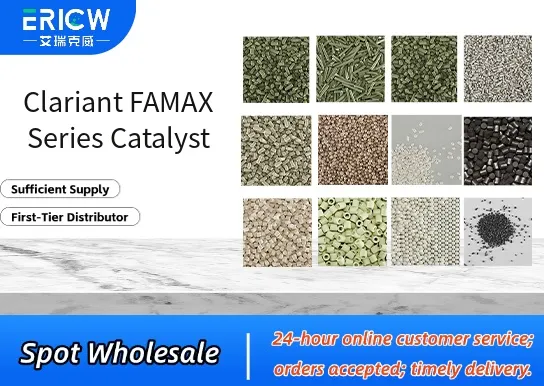
Highly selective for ammonia synthesis under moderate temperature and pressure conditions.
Exceptional long-term thermal and mechanical stability in fixed-bed reactor environments.
Optimized pore structure enabling efficient mass transfer and reduced catalyst deactivation.
Sulfur-tolerant formulation for enhanced robustness in feed gas with trace impurities.
Consistent batch-to-batch performance supported by Clariant’s ISO 9001-certified manufacturing.
Ammonia production in energy-efficient single- or multi-pressure synthesis loops.
Retrofit upgrades for aging ammonia plants seeking improved conversion and lower energy input.
Small- to medium-scale modular ammonia units, including green ammonia pilot installations.
On-site ammonia generation for refrigeration and water treatment facilities.
| Chemical Type | Iron-based promoted catalyst (Fe₃O₄ with K₂O, Al₂O₃, CaO promoters) |
| Product Form | Extrudates (cylindrical pellets, 3–5 mm diameter) |
| Appearance | Black to dark grey solid, free-flowing granules |
| Primary Applications | Low- to medium-pressure ammonia synthesis (80–200 bar, 380–480 °C) |
| Key Features | High activity onset at ≤400 °C; low methane formation; regenerable after temporary poisoning |
| Benefits | Extended cycle life (>5 years typical), reduced purge gas requirement, lower specific energy consumption |
| Storage Requirement | Dry, well-ventilated area; avoid exposure to moisture and air prior to reduction |
Q1: What is the primary function of the Clariant FAMAX Series Catalyst in polymer processing?
A: The FAMAX Series is a family of high-performance catalysts designed to accelerate crosslinking and curing reactions—particularly in silicone, polyurethane, and specialty elastomer systems—enhancing processing efficiency and final material performance without compromising thermal or mechanical stability.
Q2: How does the FAMAX Series differ from conventional tin-based catalysts?
A: Unlike traditional stannous octoate or dibutyltin dilaurate, FAMAX catalysts are organometallic compounds formulated for improved hydrolytic stability, reduced volatility, and enhanced compatibility with sensitive functional groups—making them suitable for applications requiring low odor, extended pot life, and regulatory flexibility.
Q3: Is the FAMAX Series compatible with platinum-catalyzed silicone systems?
A: FAMAX catalysts are not intended as direct replacements for platinum-based systems; they operate via distinct mechanistic pathways. However, they can be used in hybrid or multi-stage formulations where complementary catalysis is required—subject to thorough compatibility testing under application-specific conditions.
Q4: What handling precautions should be observed when working with FAMAX catalysts?
A: As with most reactive organometallic materials, standard industrial hygiene practices apply: use in well-ventilated areas, avoid prolonged skin contact, and wear appropriate PPE including nitrile gloves and safety goggles. Refer to the Safety Data Sheet (SDS) for substance-specific guidance.
Q5: Can FAMAX catalysts be used in food-contact or medical-grade polymer formulations?
A: While certain FAMAX grades have been evaluated for use in demanding end-use environments, regulatory compliance depends on the full formulation, processing conditions, and applicable regional requirements. Customers must conduct full validation—including extractables/leachables assessment—to confirm suitability for food-contact or medical applications.
Contact With Us:
E-mail: wangxingqiang@ericwchem.com
Have a Questions? Call Us:
Add:
Building A1, Jiete Industrial Park, Huangpu District, Guangzhou City, Guangdong Province, China