English
 Español
 tiếng việt
 русский
Highly selective for low-temperature oxidation of volatile organic compounds (VOCs) and CO.
Exceptional thermal and hydrothermal stability under continuous industrial operation.
Low precious metal loading optimized for cost-effective performance and long service life.
Robust resistance to common catalyst poisons including sulfur, chlorine, and siloxanes.
Designed for easy integration into fixed-bed and monolithic reactor systems.
Exhaust gas treatment in chemical manufacturing plants.
VOC abatement in paint and coating production facilities.
Odor control and emission reduction in food processing exhaust streams.
Catalytic oxidation units for pharmaceutical intermediate synthesis off-gas.
Regenerative thermal oxidizer (RTO) polishing catalyst for compliance with stringent air permits.
| Chemical Type | Supported noble metal catalyst (Pd/Pt on engineered oxide support) |
| Product Form | Extruded pellets or coated monolith (customizable geometry) |
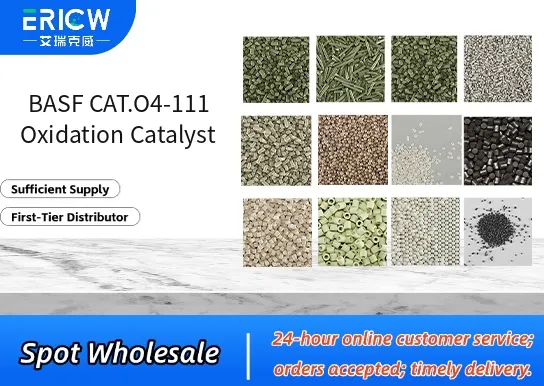
| Appearance | Gray-black cylindrical pellets or structured ceramic/metal substrate |
| Primary Applications | Oxidation of VOCs, CO, and odor-causing compounds at 150–400 °C |
| Key Features | Low light-off temperature, high conversion efficiency (>95% at design conditions), wide operating window |
| Benefits | Reduced energy consumption, extended catalyst lifetime, simplified system maintenance |
| Storage Conditions | Store in dry, well-ventilated area; avoid exposure to moisture and reducing atmospheres |
| Handling Precautions | Use appropriate PPE; avoid inhalation of dust during loading/unloading |
Q1: What is the primary function of BASF CAT.O4-111 in industrial oxidation processes?
A: BASF CAT.O4-111 is a heterogeneous oxidation catalyst designed to accelerate selective oxidation reactions under moderate temperature and pressure conditions, commonly employed in the production of intermediates for fine chemicals, agrochemicals, and specialty polymers.
Q2: Is CAT.O4-111 suitable for liquid-phase or gas-phase applications?
A: It is formulated for use in fixed-bed or slurry-phase reactor configurations and demonstrates robust performance in both vapor-phase oxidation of volatile organics and liquid-phase oxidation of functionalized substrates, depending on process design and support integration.
Q3: How does thermal stability affect catalyst lifetime in continuous operation?
A: CAT.O4-111 exhibits high thermal resilience and maintains structural integrity during prolonged exposure to elevated temperatures typical of catalytic oxidation units; gradual deactivation—primarily due to coking or trace metal accumulation—can be mitigated through periodic regeneration protocols as defined in BASF’s technical guidance.
Q4: Can CAT.O4-111 be integrated into existing reactor systems without major retrofitting?
A: Yes—the catalyst is supplied in standardized pellet or extrudate forms compatible with conventional fixed-bed reactors, and its mechanical strength and attrition resistance allow direct substitution or co-loading with other oxide-based catalysts in multi-zone configurations.
Contact With Us:
E-mail: wangxingqiang@ericwchem.com
Have a Questions? Call Us:
Add:
Building A1, Jiete Industrial Park, Huangpu District, Guangzhou City, Guangdong Province, China