English
 Español
 tiếng việt
 русский
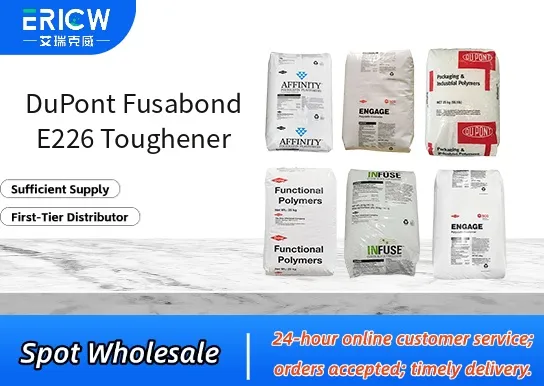
Maleic anhydride-grafted ethylene–propylene copolymer offering excellent compatibility with polyolefins and engineering thermoplastics.
Enhances impact strength and ductility without compromising melt flow or thermal stability.
Enables robust interfacial adhesion in multi-material systems, including PP/PA, PP/PC, and TPO composites.
Low volatility and minimal odor—suitable for automotive interior and consumer applications requiring low VOC emissions.
Consistent performance across extrusion, injection molding, and compounding processes.
Automotive interior trim components (e.g., door panels, dashboards, pillar covers).
Toughened polypropylene (PP) compounds for structural under-hood parts.
Multi-material bonding layers in co-extruded profiles and laminated sheets.
Recycled PP upcycling—improves mechanical properties and processability of post-consumer regrind.
Engineering plastic blends requiring enhanced toughness and dimensional stability.
| Chemical Type | Maleic anhydride-grafted ethylene–propylene copolymer |
| Product Form | Pellets |
| Appearance | Off-white to light tan cylindrical pellets |
| Primary Applications | Polyolefin toughening, polymer alloy compatibilization, recycled material enhancement |
| Key Features | High grafting efficiency, low extractables, broad processing window |
| Benefits | Improved impact resistance, reduced notch sensitivity, enhanced adhesion in layered structures |
| Recommended Processing Temperature Range | 180–240 °C |
| Storage Conditions | Store in cool, dry location; keep container sealed to prevent moisture absorption |
Contact With Us:
E-mail: wangxingqiang@ericwchem.com
Have a Questions? Call Us:
Add:
Building A1, Jiete Industrial Park, Huangpu District, Guangzhou City, Guangdong Province, China