English
 Español
 tiếng việt
 русский
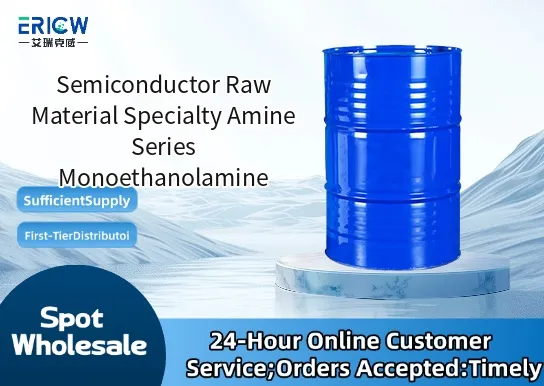
Ultra-high purity (≥99.99% GC) with trace metal impurities strictly controlled to sub-ppb levels (e.g., Na, K, Fe, Cu < 10 ppt).
Low volatility and thermally stable formulation optimized for precision semiconductor wet processing environments.
Consistent batch-to-batch reproducibility certified via dual QC testing (GC-MS + ICP-MS).
Non-corrosive to high-purity quartz, silicon, and stainless-steel process equipment when used within recommended concentration and temperature ranges.
Compatible with ultra-low particle generation protocols (<1 particle/mL @ ≥0.1 µm per ISO 14644-1 Class 1).
Formulation component in advanced photoresist strippers for 7 nm–3 nm logic and memory device fabrication.
pH buffering agent in post-CMP (Chemical Mechanical Planarization) cleaning solutions for copper/low-k interconnects.
Stabilizer and complexing ligand in electroless copper plating baths for through-silicon via (TSV) metallization.
Co-solvent in high-selectivity etch inhibitors for SiO₂/SiNₓ pattern transfer processes.
Raw material for synthesizing semiconductor-grade amine-functionalized surface modifiers in atomic layer deposition (ALD) precursors.
| Chemical Type | Primary alkanolamine (2-aminoethanol) |
| Product Form | Liquid, clear, colorless |
| Appearance | Clear, water-white liquid, free of suspended particles or haze |
| Melting Point | 10.5 °C (typical) |
| Boiling Point (at 760 mmHg) | 170–172 °C |
| Primary Applications | Photoresist stripping, CMP cleaning, ALD precursor synthesis, electroless plating stabilization |
| Key Features | Ultra-low metallic impurities, low particle count, high thermal stability, batch-certified purity |
| Regulatory Compliance | REACH compliant; RoHS 2015/863 Annex II compliant; no SVHCs above 0.1 wt% |
| Common Compatible Systems | Suitability |
| High-purity deionized water (UPW) delivery systems | Highly Recommended – Fully miscible; no precipitation or leaching observed in fluoropolymer-lined piping |
| Quartz and fused silica process tanks | Highly Recommended – Non-reactive up to 80 °C; validated for >1,000 hr exposure |
| Electropolished 316L stainless steel wet benches | Recommended – Requires pH control (pH ≤ 10.5) to prevent long-term amine-induced stress corrosion |
| PFA and ETFE fluid-handling components | Highly Recommended – No swelling, extraction, or degradation observed under standard operating conditions |
| UV/Ozone cleaning modules | Suitable – Stable under ambient UV irradiation; not intended for direct ozone contact without dilution |
Q1: What is the CAS Number for this specialty monoethanolamine grade?
A: The CAS Number is 141-43-5. This refers specifically to the ultra-high-purity semiconductor-grade monoethanolamine (MEA) conforming to SEMI C37-0322 specifications.
Q2: What is the recommended usage concentration in photoresist stripper formulations?
A: Typical working concentrations range from 5–15 wt% in aqueous-organic blends; exact dosage depends on resist type, film thickness, and process temperature—validation via DOE is strongly advised prior to fab integration.
Q3: How does this specialty MEA differ from commercial-grade monoethanolamine?
A: Unlike technical-grade MEA, this product undergoes multi-stage distillation, sub-micron filtration, and inert-gas purging to achieve <10 ppt metallic impurities, <0.1 NTU haze, and zero detectable amines (e.g., diethanolamine, triethanolamine) by GC-MS.
Q4: Is there data available on extractables/migratables into UPW streams?
A: Yes—per SEMI F57-0301 testing, extractables in UPW at 25 °C after 72-hr contact are <0.5 ppb total organic carbon (TOC), with no detectable amine-related byproducts (LOD: 0.05 ppb via LC-MS/MS).
Q5: Does this material meet USP or EP pharmaceutical standards?
A: No—it is engineered exclusively for semiconductor manufacturing and does not carry USP/EP monograph compliance; it meets SEMI C37, ASTM D1193 Type I water compatibility, and JEDEC J-STD-020 moisture sensitivity requirements.
Contact With Us:
E-mail: wangxingqiang@ericwchem.com
Have a Questions? Call Us:
Add:
Building A1, Jiete Industrial Park, Huangpu District, Guangzhou City, Guangdong Province, China