English
 Español
 tiếng việt
 русский
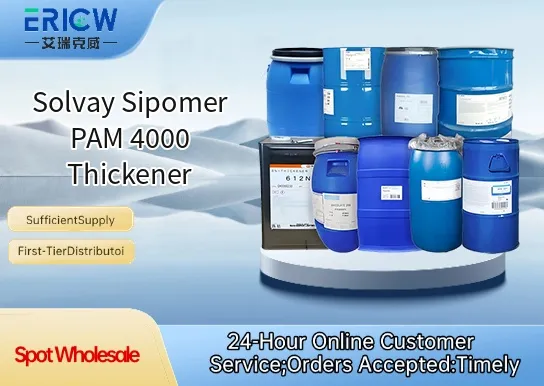
High-efficiency associative thickener based on polyacrylamide chemistry.
Delivers excellent rheology control and shear-thinning behavior in aqueous systems.
Compatible with a broad range of surfactants, electrolytes, and pH conditions (pH 3–12).
Enables low-foaming performance ideal for high-shear industrial formulations.
Provides long-term viscosity stability and resistance to microbial degradation.
Architectural coatings and interior/exterior paints.
Industrial maintenance coatings and protective finishes.
Agrochemical suspensions and sprayable formulations.
Home care detergents and liquid cleaning concentrates.
Construction chemicals including tile adhesives and grouts.
| Chemical Type | Associative polyacrylamide (PAM) thickener |
| Product Form | Off-white to light yellow viscous liquid |
| Appearance | Homogeneous, free-flowing liquid |
| Active Content | Approx. 40 wt% in aqueous solution |
| pH (1% aqueous solution) | 3.5 – 5.5 |
| Density (25°C) | 1.08 – 1.12 g/cm³ |
| Solubility | Readily dispersible and soluble in water |
| Storage Stability | 12 months unopened at 5–30°C |
Q1: What type of thickening mechanism does Sipomer PAM 4000 provide in aqueous systems?
A: Sipomer PAM 4000 functions primarily through associative thickening—its hydrophobically modified polyacrylamide structure forms transient intermolecular networks in water, delivering efficient viscosity build-up and excellent shear-thinning behavior without requiring high polymer loading.
Q2: Is Sipomer PAM 4000 compatible with common surfactants and electrolytes found in industrial cleaning or personal care formulations?
A: Yes, it demonstrates good compatibility with anionic, nonionic, and amphoteric surfactants, and maintains performance across a moderate range of electrolyte concentrations—though high salt levels may reduce thickening efficiency and should be evaluated empirically in the final formulation.
Q3: How should Sipomer PAM 4000 be incorporated into a formulation to ensure optimal dispersion and activation?
A: It is recommended to pre-dilute the product in deionized water or a low-surfactant phase before gradual addition to the main batch under moderate agitation. Avoid direct addition to highly ionic or high-surfactant environments without dilution, as this may hinder full hydration and network formation.
Q4: Does Sipomer PAM 4000 offer any rheological benefits beyond viscosity enhancement?
A: Yes—it imparts pronounced pseudoplasticity and improved suspension stability, helping to prevent settling of particulates in liquid formulations while supporting desirable flow and leveling properties during application.
Contact With Us:
E-mail: wangxingqiang@ericwchem.com
Have a Questions? Call Us:
Add:
Building A1, Jiete Industrial Park, Huangpu District, Guangzhou City, Guangdong Province, China