English
 Español
 tiếng việt
 русский
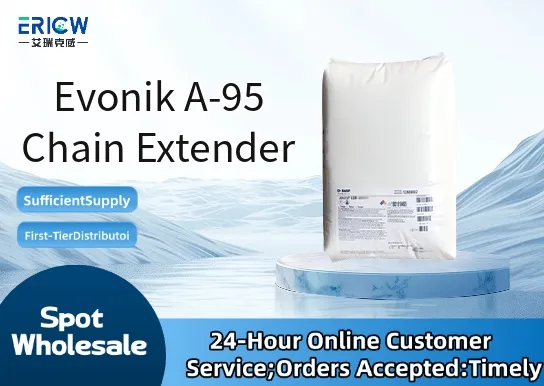
High reactivity with isocyanates, enabling efficient chain extension in polyurethane systems.
Low volatility and excellent thermal stability for safe handling and processing at elevated temperatures.
Consistent molecular structure ensures reproducible mechanical properties in final elastomers and coatings.
Compatible with aromatic and aliphatic isocyanate systems, offering formulation flexibility.
Minimal color formation during curing, supporting high-clarity applications in transparent PU elastomers.
Thermoplastic polyurethane (TPU) production for extrusion and injection molding grades.
Cast elastomer systems requiring high tensile strength and abrasion resistance.
High-performance polyurethane adhesives and sealants.
Automotive interior components including instrument panel skins and trim parts.
Roller and industrial belt formulations demanding dynamic fatigue resistance.
| Chemical Type | Aromatic diamine-based chain extender |
| Product Form | Off-white to light tan crystalline solid |
| Appearance | Crystalline powder or granules |
| Molecular Weight (approx.) | 212 g/mol |
| Melting Range | 80–85 °C |
| Primary Applications | TPU, cast elastomers, polyurethane adhesives |
| Key Features | Fast-reacting, low-migration, high-modulus contributor |
| Storage Conditions | Store in cool, dry place under inert atmosphere; protect from moisture |
Q1: What is the primary chemical functionality of Evonik A-95?
A: Evonik A-95 is a low-viscosity, aliphatic diamine-based chain extender designed for polyurethane and polyurea systems. Its dual primary amine groups enable rapid and efficient reaction with isocyanates to build molecular weight and enhance mechanical properties.
Q2: How does A-95 compare to aromatic chain extenders like MOCA in terms of processing and performance?
A: Unlike aromatic alternatives, A-95 offers improved UV stability and color retention due to its aliphatic structure, making it suitable for light-stable elastomers and coatings. It also provides shorter pot life and faster demold times than many slower-reacting diamines, though its reactivity is more controllable than highly reactive aromatic diamines.
Q3: What types of polyurethane systems is A-95 typically used in?
A: A-95 is widely employed in cast elastomers, reaction injection molding (RIM), and spray polyurea applications where high tensile strength, abrasion resistance, and thermal resilience are required. It is especially valued in formulations demanding excellent dynamic mechanical properties and clarity.
Q4: Is A-95 compatible with common polyol blends and prepolymers?
A: Yes — A-95 demonstrates broad compatibility with polyester, polyether, and polycarbonate diols, as well as MDI- and HDI-based prepolymers. Its low viscosity facilitates homogeneous mixing without requiring elevated temperatures or extended dispersion time.
Q5: What handling precautions should be observed when working with A-95?
A: As with all amine-based chain extenders, A-95 should be handled in well-ventilated areas using appropriate personal protective equipment (PPE), including nitrile gloves and chemical-resistant goggles. It is hygroscopic and sensitive to moisture; therefore, storage under dry nitrogen and tight container closure is recommended to maintain reactivity and shelf life.
Contact With Us:
E-mail: wangxingqiang@ericwchem.com
Have a Questions? Call Us:
Add:
Building A1, Jiete Industrial Park, Huangpu District, Guangzhou City, Guangdong Province, China