English
 Español
 tiếng việt
 русский
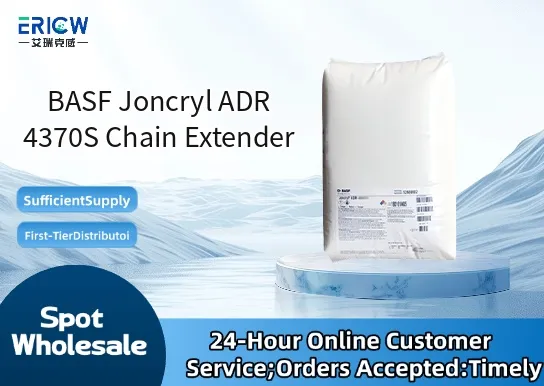
Highly efficient epoxy-functional chain extender for reactive processing of polyesters and polyacrylates.
Enables precise molecular weight control and improved melt strength in extrusion and injection molding.
Thermally stable up to 220 °C, supporting robust processing without premature degradation.
Low volatility and minimal odor—ideal for applications requiring low VOC emissions.
Compatible with standard compounding equipment; no special handling or drying required.
Recycled PET (rPET) upgrading for food-contact and high-clarity packaging films.
Engineering thermoplastic polyester blends requiring enhanced toughness and dimensional stability.
Automotive interior components where improved flow behavior and weld-line strength are critical.
3D printing filaments based on recycled polyesters needing consistent melt viscosity and layer adhesion.
Monofilament and industrial yarns demanding high tensile strength and thermal resistance.
| Chemical Type | Epoxy-functional styrene-acrylic copolymer |
| Product Form | Pellets |
| Appearance | Off-white to light beige, free-flowing pellets |
| Primary Applications | Chain extension and branching of polyesters, polyacrylates, and biopolymers |
| Key Features | Reactive functionality, thermal stability, compatibility with common polymer matrices |
| Benefits | Improved melt strength, enhanced mechanical properties, recyclate valorization |
| Storage Conditions | Store in original sealed packaging at 15–25 °C; protect from moisture |
| Processing Temperature Range | 180–220 °C |
Q1: What is the primary function of Joncryl ADR 4370S in polymer systems?
A: Joncryl ADR 4370S is a multifunctional epoxy-based chain extender designed to increase molecular weight and improve melt strength, viscosity, and mechanical performance—particularly in recycled or degraded polyesters, polyacrylates, and other condensation polymers.
Q2: Which polymer types is Joncryl ADR 4370S most commonly used with?
A: It is especially effective in PET, PBT, and other aromatic polyesters, as well as acrylic resins and certain biodegradable polyesters. Its reactivity profile makes it suitable for both virgin and post-consumer recycled feedstocks where chain scission has occurred.
Q3: How is Joncryl ADR 4370S typically incorporated into a formulation?
A: It is generally added directly during compounding—either via side-stuffer feeder or liquid injection—under standard melt processing conditions. No pre-drying is required, and it disperses readily in molten polymer matrices.
Q4: Does Joncryl ADR 4370S affect thermal stability or color development during processing?
A: When used within recommended dosage ranges, it exhibits good thermal stability up to typical polyester processing temperatures and does not promote significant yellowing—though extended residence time at elevated temperatures should be minimized as with any reactive additive.
Q5: Can Joncryl ADR 4370S be used in food-contact or regulated applications?
A: It is not pre-approved for direct food-contact use under major global regulatory frameworks. Formulators must conduct full regulatory evaluation—including compatibility, migration assessment, and end-use compliance—based on their specific application and jurisdiction.
Contact With Us:
E-mail: wangxingqiang@ericwchem.com
Have a Questions? Call Us:
Add:
Building A1, Jiete Industrial Park, Huangpu District, Guangzhou City, Guangdong Province, China