English
 Español
 tiếng việt
 русский
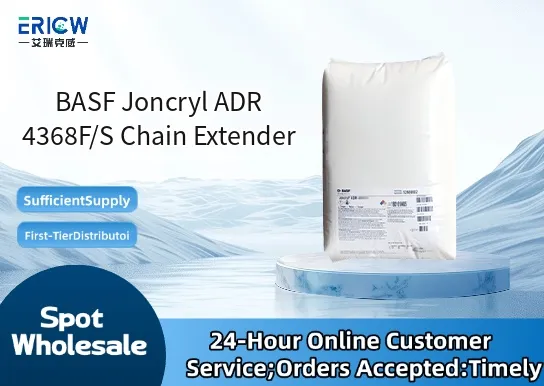
Highly efficient epoxy-functional chain extender for polyesters and polyacrylates.
Enables precise molecular weight control without significant gelation risk.
Improves melt viscosity and rheological stability during extrusion and processing.
Compatible with standard compounding equipment and widely used in reactive extrusion.
Supports low-VOC formulations with no volatile by-products formed during reaction.
Recycled PET (rPET) upcycling for fiber and packaging applications.
Enhancement of mechanical properties in engineering thermoplastics.
Viscosity stabilization in water-based and solvent-borne coatings resins.
Chain extension of bio-based polyesters (e.g., PLA, PEA) for improved processability.
Performance improvement in hot-melt adhesives requiring thermal stability.
| Chemical Type | Epoxy-functional styrene-acrylic copolymer |
| Product Form | Powder |
| Appearance | White to off-white free-flowing powder |
| Primary Applications | Chain extension, branching, and crosslinking of polyesters, polyacrylates, and polyolefins |
| Key Features | Reactive functionality: ~3.5 epoxy groups per molecule (average) |
| Benefits | Enables solid-state polymerization support and enhances melt strength |
| Storage Conditions | Store in cool, dry place below 25°C; protect from moisture |
| Handling Precautions | Use in well-ventilated areas; avoid inhalation of dust |
Q1: What is the primary function of Joncryl ADR 4368F/S in polymer systems?
A: Joncryl ADR 4368F/S is a multifunctional epoxy-based chain extender designed to increase molecular weight and improve melt strength, viscosity, and mechanical performance—particularly in recycled or degraded polyesters, polyacrylates, and other condensation polymers.
Q2: How does ADR 4368F/S differ from standard monofunctional chain extenders?
A: Unlike monofunctional extenders that only add end-group functionality, ADR 4368F/S contains multiple epoxy groups per molecule, enabling branching and controlled crosslinking—enhancing rheological stability and processability without excessive gelation when dosed appropriately.
Q3: Is Joncryl ADR 4368F/S suitable for food-contact applications?
A: Joncryl ADR 4368F/S is not pre-approved for direct food contact; its suitability depends on final formulation compliance, regulatory review, and migration testing under applicable regional frameworks. Customers must validate compliance with relevant food contact regulations for their specific application and processing conditions.
Q4: What are typical processing considerations during compounding with ADR 4368F/S?
A: It is typically added during extrusion or melt compounding at temperatures above the polymer’s melting point but below the onset of significant epoxy ring degradation. Uniform dispersion is critical, and residence time should be optimized to balance chain extension efficacy against potential side reactions or viscosity overshoot.
Q5: How should Joncryl ADR 4368F/S be stored and handled?
A: Store in original sealed containers at cool, dry conditions (preferably below 25 °C) and protect from moisture, heat, and prolonged exposure to ambient humidity. Handle using appropriate PPE, as epoxy-containing materials may cause skin or eye irritation upon direct contact.
Contact With Us:
E-mail: wangxingqiang@ericwchem.com
Have a Questions? Call Us:
Add:
Building A1, Jiete Industrial Park, Huangpu District, Guangzhou City, Guangdong Province, China