English
 Español
 tiếng việt
 русский
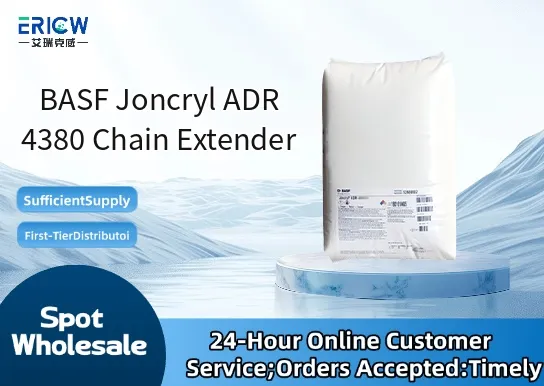
Highly efficient epoxy-functional chain extender for polyester and polyacrylate resins.
Enables precise molecular weight control without significant gelation risk.
Improves melt viscosity, mechanical strength, and thermal stability of recycled and virgin polymers.
Compatible with extrusion and compounding processes at standard processing temperatures.
Low volatility and minimal odor—suitable for food-contact-compliant formulations (when used as directed).
Enhancement of post-consumer PET and PLA recyclates in packaging films and trays.
Viscosity stabilization in waterborne acrylic dispersions for industrial coatings.
Molecular weight adjustment in thermoplastic polyurethane (TPU) compounds.
Performance improvement of bio-based polyesters in injection-molded automotive interior parts.
| Chemical Type | Epoxy-functional oligomer (multi-epoxy) |
| Product Form | Pellets |
| Appearance | Off-white to light beige, free-flowing pellets |
| Primary Applications | Polyester, polyacrylate, and polyurethane modification; polymer recycling |
| Key Features | Chain extension, branching control, melt rheology enhancement |
| Benefits | Improved tensile strength, impact resistance, and processability |
| Storage Conditions | Store in original sealed container at 15–25 °C; protect from moisture |
Q1: What is the primary function of Joncryl ADR 4380 in polymer systems?
A: Joncryl ADR 4380 is a multifunctional epoxy-based chain extender designed to increase molecular weight and improve melt strength, viscosity, and mechanical performance—particularly in recycled or degraded polyesters, polyacrylates, and other condensation polymers.
Q2: Which polymer types are most commonly modified using Joncryl ADR 4380?
A: It is widely used with post-consumer and post-industrial PET, PBT, and PLA, as well as acrylic dispersions and waterborne coatings. Its reactivity profile makes it especially effective in systems containing carboxyl or hydroxyl end groups.
Q3: How is Joncryl ADR 4380 typically incorporated into a formulation?
A: It is generally added during melt compounding or extrusion, often downstream of the main polymer feed. Due to its thermal stability and low volatility, it can be introduced directly into the extruder barrel without pre-drying or special handling under standard processing conditions.
Q4: Does Joncryl ADR 4380 impact the color or clarity of transparent polymer applications?
A: When used at recommended dosages, it typically has minimal effect on yellowness index or haze in clear PET or PLA formulations—though final optical properties depend on base resin quality, thermal history, and overall formulation balance.
Q5: Is Joncryl ADR 4380 compatible with common additives such as stabilizers, nucleating agents, or pigments?
A: Yes—it demonstrates broad compatibility with conventional polymer additives, including phosphite and phenolic antioxidants, calcium stearate, and organic pigments. However, compatibility should always be verified in the final application due to potential interactions with highly acidic or reactive components.
Contact With Us:
E-mail: wangxingqiang@ericwchem.com
Have a Questions? Call Us:
Add:
Building A1, Jiete Industrial Park, Huangpu District, Guangzhou City, Guangdong Province, China