English
 Español
 tiếng việt
 русский
High solids content for reduced VOC emissions and improved coating efficiency.
Excellent UV resistance and long-term gloss retention in exterior applications.
Good compatibility with common crosslinkers including melamine and polyisocyanates.
Superior flow and leveling properties for smooth, defect-free film formation.
Enhanced weatherability and color stability under accelerated aging conditions.
Automotive OEM and refinish topcoats.
Industrial maintenance coatings for metal substrates.
Architectural high-performance façade coatings.
Plastic coatings requiring adhesion and flexibility.
General-purpose solventborne decorative and protective coatings.
| Chemical Type | Acrylic copolymer resin |
| Product Form | Liquid solution in aromatic hydrocarbons |
| Appearance | Clear, pale yellow liquid |
| Solids Content (wt%) | 55–60% |
| Viscosity (mPa·s, 23°C) | 1,200–2,500 |
| Acid Value (mg KOH/g) | 5–12 |
| Glass Transition Temperature (Tg, °C) | ~75 |
| Primary Applications | High-gloss automotive and industrial topcoats |
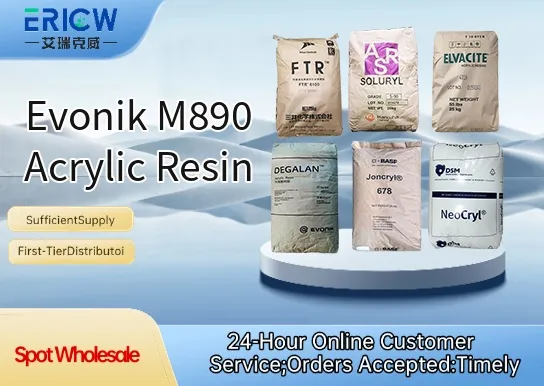
Q1: What is the primary function of Evonik M890 Acrylic Resin in coating formulations?
A: Evonik M890 is a reactive acrylic resin designed to serve as a rheology modifier and performance enhancer—particularly for improving sag resistance, leveling, and edge coverage in solvent-borne and high-solids industrial coatings.
Q2: Is M890 compatible with common crosslinkers used in thermosetting coatings?
A: Yes, M890 demonstrates good compatibility with standard amino resins (e.g., melamine-formaldehyde) and isothiocyanate-based hardeners, enabling its use in baked coil and automotive OEM-type systems without significant formulation instability.
Q3: How should M890 be incorporated into a coating formulation to ensure optimal dispersion and activation?
A: It is recommended to add M890 during the let-down stage under moderate agitation, followed by sufficient hold time to allow full swelling and interaction with the binder system. Pre-dilution in a compatible solvent may aid uniform distribution, especially in low-viscosity systems.
Q4: Does M890 impact the gloss or surface appearance of cured films?
A: When properly formulated and cured, M890 typically does not compromise gloss retention or introduce haze—it supports high-gloss, smooth finishes while enhancing film integrity and mechanical durability.
Q5: What storage conditions are recommended to maintain M890’s stability and performance?
A: Store in original sealed containers at temperatures between 10 °C and 30 °C, away from direct sunlight and moisture. Prolonged exposure to freezing or excessive heat should be avoided to preserve molecular integrity and rheological consistency.
Contact With Us:
E-mail: wangxingqiang@ericwchem.com
Have a Questions? Call Us:
Add:
Building A1, Jiete Industrial Park, Huangpu District, Guangzhou City, Guangdong Province, China