English
 Español
 tiếng việt
 русский
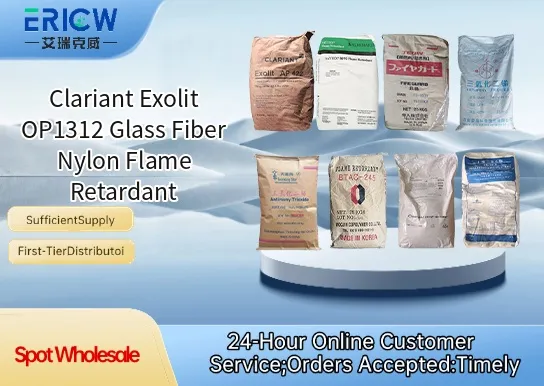
Halogen-free phosphorus-based flame retardant specifically engineered for glass fiber–reinforced polyamide 6 and 66 compounds.
Enables excellent UL 94 V-0 rating at thin wall sections (0.8 mm) without compromising mechanical performance.
Offers superior thermal stability during high-temperature processing (up to 290 °C) and minimal plate-out or blooming.
Maintains high flowability and dimensional stability in injection-molded parts, supporting complex geometries.
Provides low smoke density and reduced toxic gas emission versus brominated alternatives, meeting stringent fire safety regulations.
Electrical and electronic housings (e.g., connectors, switches, circuit breakers).
Automotive under-hood components (e.g., sensor housings, ignition system parts).
Industrial automation enclosures requiring high tracking resistance and flame retardancy.
Consumer appliance parts exposed to elevated temperatures and electrical hazards.
Railway interior components compliant with EN 45545-2 fire behavior requirements.
| Chemical Type | Organophosphorus compound (phosphinate-based) |
| Product Form | Free-flowing white granules |
| Appearance | Off-white to light beige granules |
| Primary Applications | Glass fiber–reinforced PA6 and PA66 |
| Key Features | Halogen-free, RoHS-compliant, REACH registered |
| Benefits | Enhanced processability, low corrosion, recyclable formulation compatibility |
| Density (23 °C) | ~1.4 g/cm³ |
| Recommended Loading Range | 12–18 wt% in GF-PA6/66 |
Q1: What is the primary application of Exolit OP1312 in glass fiber–reinforced nylon systems?
A: Exolit OP1312 is specifically engineered to provide halogen-free flame retardancy in glass fiber–filled polyamide 6 and polyamide 66 compounds, enabling compliance with stringent fire safety standards for demanding engineering applications such as electrical connectors, automotive under-hood components, and industrial housings.
Q2: How does Exolit OP1312 affect mechanical properties in reinforced nylon formulations?
A: When properly compounded, Exolit OP1312 helps preserve key mechanical performance—such as tensile strength, impact resistance, and dimensional stability—especially in glass fiber–reinforced nylons. Its optimized particle morphology and surface treatment support good dispersion and interfacial compatibility, minimizing adverse effects on structural integrity.
Q3: Is Exolit OP1312 compatible with common processing methods for nylon compounds?
A: Yes, Exolit OP1312 is designed for robust performance during standard thermoplastic processing techniques—including twin-screw compounding, injection molding, and extrusion—without significant degradation or volatilization, even at typical nylon processing temperatures up to 290 °C.
Q4: Does Exolit OP1312 require additional synergists or stabilizers in nylon formulations?
A: While Exolit OP1312 functions effectively as a standalone flame retardant in many glass fiber–nylon systems, optimal performance—particularly regarding long-term thermal stability and afterflame behavior—may benefit from complementary stabilization packages, including appropriate antioxidants and processing aids, tailored to the specific end-use requirements.
Contact With Us:
E-mail: wangxingqiang@ericwchem.com
Have a Questions? Call Us:
Add:
Building A1, Jiete Industrial Park, Huangpu District, Guangzhou City, Guangdong Province, China