English
 Español
 tiếng việt
 русский
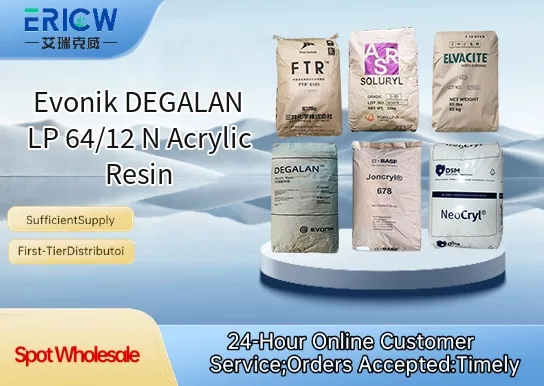
High molecular weight acrylic copolymer delivering excellent film-forming properties and mechanical strength.
Low volatile organic compound (VOC) content, supporting compliance with stringent environmental regulations.
Outstanding UV resistance and long-term weatherability for durable outdoor performance.
Good compatibility with common solvents, plasticizers, and other acrylic or cellulose-based resins.
Controlled rheology enabling smooth application and uniform film formation in coating systems.
Automotive refinish coatings requiring high gloss and chip resistance.
Industrial maintenance coatings for metal and concrete substrates.
Architectural façade and cladding coatings exposed to harsh environmental conditions.
Plastic coatings for ABS, PC, and PP substrates requiring adhesion and flexibility.
High-performance clearcoats in two-component solventborne systems.
| Chemical Type | Acrylic copolymer (methyl methacrylate / butyl acrylate / methacrylic acid) |
| Product Form | Solventborne resin solution |
| Appearance | Clear, colorless to pale yellow liquid |
| Solvent System | Xylene / butyl acetate blend |
| Solids Content | 64 ± 1 wt% |
| Viscosity (25°C, DIN ISO 2535, #4 spindle, 60 rpm) | Approx. 12,000–16,000 mPa·s |
| Acid Value | 12 ± 2 mg KOH/g |
| Specific Gravity (20°C) | Approx. 0.98–1.02 g/cm³ |
Q1: What is the primary function of DEGALAN LP 64/12 N in coating formulations?
A: DEGALAN LP 64/12 N functions primarily as a rheology modifier and matting agent, helping to control viscosity, improve sag resistance, and deliver consistent, low-sheen surface appearance in solvent-borne and high-solids acrylic coatings.
Q2: Is DEGALAN LP 64/12 N compatible with common acrylic and polyester resin systems?
A: Yes — it is specifically designed for compatibility with acrylic, polyester, and alkyd resins in solvent-based industrial and decorative coatings. Compatibility should always be verified under actual formulation conditions, including solvent blend and curing schedule.
Q3: How does DEGALAN LP 64/12 N differ from conventional silica-based matting agents?
A: Unlike fumed or precipitated silicas, DEGALAN LP 64/12 N is an organic acrylic polymer dispersion offering improved transparency, reduced abrasion during processing, and more predictable rheological behavior without significant impact on gloss uniformity or film clarity.
Q4: What are typical dosage guidelines for achieving optimal matting performance?
A: Dosage depends on the target gloss level, film thickness, and base resin system, but it is typically used at low concentrations — generally ranging from 0.1% to 2% by weight relative to total formulation solids — with incremental adjustment recommended during lab-scale trials.
Q5: Does DEGALAN LP 64/12 N require special handling or pre-dispersion before incorporation?
A: It is supplied as a stable aqueous dispersion and can be incorporated directly into the grind or let-down phase using low-shear mixing. High-shear dispersion is not required, though gentle homogenization ensures uniform distribution and avoids localized agglomeration.
Contact With Us:
E-mail: wangxingqiang@ericwchem.com
Have a Questions? Call Us:
Add:
Building A1, Jiete Industrial Park, Huangpu District, Guangzhou City, Guangdong Province, China