English
 Español
 tiếng việt
 русский
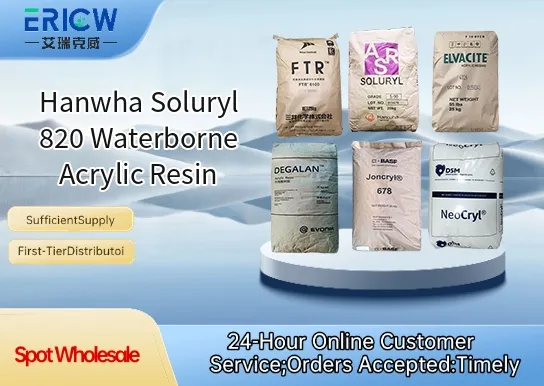
High solids content for improved film build and application efficiency.
Excellent water resistance and alkali stability in formulated coatings.
Low VOC formulation compatibility, supporting stringent environmental compliance.
Good pigment wetting and dispersion stability in aqueous systems.
Enhanced hardness development and scrub resistance in dry films.
Architectural interior and exterior wall paints.
Industrial maintenance coatings for metal substrates.
Waterborne wood finishes and clear topcoats.
Functional primers requiring adhesion to low-surface-energy substrates.
Low-VOC industrial coil coatings (pre-treatment compatible).
| Chemical Type | Acrylic copolymer, anionic emulsion |
| Product Form | White to slightly bluish opaque liquid |
| Appearance | Homogeneous, free of coarse particles or gel |
| Solids Content (wt%) | 45.0 ± 1.0 |
| pH (at 25°C) | 7.8 – 8.5 |
| Minimum Film Formation Temperature (MFFT) | 22°C |
| Viscosity (Brookfield RVT, #2 spindle, 20 rpm, 25°C) | 500 – 1500 cP |
| Particle Size (D50) | 120 – 160 nm |
Q1: What are the primary application areas for Soluryl 820?
A: Soluryl 820 is primarily formulated into high-performance waterborne industrial coatings, including metal primers, topcoats for appliances and general industrial equipment, and protective clearcoats where low VOC, good film formation, and balanced hardness-flexibility are required.
Q2: How does Soluryl 820 perform in terms of drying and film formation at ambient conditions?
A: Soluryl 820 exhibits excellent ambient-temperature film formation due to its optimized particle size and coalescing behavior, enabling robust, continuous films without added coalescents in many formulations. Dry-to-touch time is typically fast under standard conditions, supporting efficient production workflows.
Q3: Is Soluryl 820 compatible with common waterborne crosslinkers?
A: Yes — Soluryl 820 is designed for compatibility with a range of commercially available waterborne crosslinkers, including melamine-formaldehyde resins, aziridine-based systems, and polyisocyanate dispersions, enabling formulation of both ambient-cure and heat-cure coating systems.
Q4: Can Soluryl 820 be used in direct-to-metal (DTM) applications?
A: Yes — when properly formulated with suitable corrosion inhibitors, pigments, and rheology modifiers, Soluryl 820 serves as an effective binder in DTM coatings for mild to moderate service environments, offering good adhesion and barrier properties on ferrous and non-ferrous substrates.
Contact With Us:
E-mail: wangxingqiang@ericwchem.com
Have a Questions? Call Us:
Add:
Building A1, Jiete Industrial Park, Huangpu District, Guangzhou City, Guangdong Province, China