English
 Español
 tiếng việt
 русский
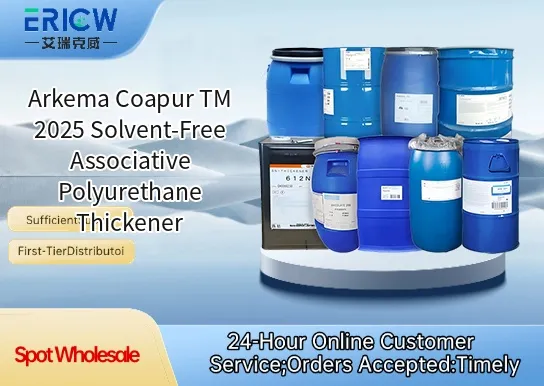
100% solvent-free formulation, supporting VOC-compliant and sustainable coating systems.
High-efficiency associative thickening provides excellent rheology control in both low- and high-shear conditions.
Outstanding compatibility with acrylic, styrene-acrylic, and vinyl acetate-based latexes.
Delivers superior spatter resistance, brush drag reduction, and sag resistance in architectural coatings.
Stable performance across broad pH range (pH 6–10) and minimal sensitivity to electrolytes.
Interior and exterior architectural waterborne paints.
Waterborne wood coatings for furniture and flooring.
Industrial maintenance coatings requiring high film integrity and leveling.
Low-VOC decorative wall coatings and textured finishes.
Waterborne primers and undercoats for construction and DIY applications.
| Chemical Type | Solvent-free associative polyurethane (HEUR) |
| Product Form | Viscous liquid |
| Appearance | Off-white to light beige, homogeneous paste |
| pH (1% aqueous solution) | 7.0–8.5 |
| Non-Volatile Content (wt%) | 35–40% |
| Viscosity (Brookfield RVT, spindle #3, 20 rpm, 25°C) | 15,000–30,000 cP |
| Primary Applications | Waterborne architectural and industrial coatings |
| Key Features | Solvent-free, HEUR-type, electrolyte-tolerant, low-foaming |
Q1: What makes Coapur TM 2025 different from conventional associative thickeners?
A: Coapur TM 2025 is a solvent-free, high-performance associative polyurethane thickener designed to deliver robust rheology control without volatile organic compounds. Its unique molecular architecture provides excellent shear-thinning behavior, superior film formation integrity, and enhanced compatibility with low-VOC and waterborne systems compared to many traditional HEUR thickeners.
Q2: Is Coapur TM 2025 suitable for use in architectural coatings and industrial maintenance paints?
A: Yes — it is widely used in interior and exterior architectural coatings, including flat and low-sheen formulations, where it imparts excellent sag resistance, brush/roller drag reduction, and spatter control. It also performs well in industrial maintenance paints requiring balanced flow and leveling with good post-application stability.
Q3: How should Coapur TM 2025 be incorporated into a formulation?
A: It is typically added during the let-down stage, after pigments and fillers are fully dispersed and pH has been adjusted. Pre-dilution with water or compatible co-solvent may aid uniform dispersion. Avoid high-shear addition directly to highly viscous phases; gentle mixing until homogeneous is recommended.
Q4: Does Coapur TM 2025 require neutralization or pH adjustment before use?
A: No — unlike some alkaline-swellable thickeners, Coapur TM 2025 is non-ionic and does not rely on pH activation. It functions effectively across a broad pH range (typically pH 4–11), offering greater formulation flexibility and reduced sensitivity to pH drift during storage or application.
Contact With Us:
E-mail: wangxingqiang@ericwchem.com
Have a Questions? Call Us:
Add:
Building A1, Jiete Industrial Park, Huangpu District, Guangzhou City, Guangdong Province, China