English
 Español
 tiếng việt
 русский
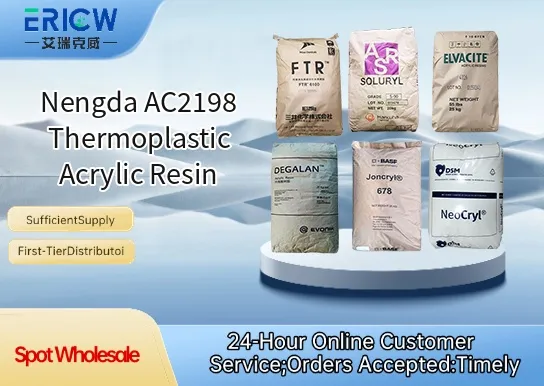
Excellent clarity and high gloss retention after film formation.
Superior UV resistance and long-term color stability under outdoor exposure.
Good solubility in common organic solvents including toluene, xylene, and ethyl acetate.
Outstanding thermoplastic processability with sharp melt transition and low melt viscosity.
Strong adhesion to diverse substrates such as metals, plastics, and coated papers.
Automotive clearcoats and OEM topcoats requiring high durability and gloss.
Industrial maintenance coatings for metal and plastic components.
High-performance inks for flexible packaging and label printing.
Thermoplastic powder coating binders for decorative and functional finishes.
Adhesive modifiers in pressure-sensitive and hot-melt adhesive formulations.
| Chemical Type | Thermoplastic acrylic copolymer |
| Product Form | Pale yellow granules or free-flowing powder |
| Appearance | Transparent to slightly hazy solid |
| Glass Transition Temperature (Tg) | 105–110 °C (DSC, 10 °C/min) |
| Melt Flow Index (MFI) | 8–12 g/10 min @ 200 °C / 5 kg |
| Solubility | Readily soluble in aromatic and ketonic solvents; insoluble in water |
| Primary Applications | Clearcoats, industrial coatings, specialty inks, adhesive modifiers |
| Key Features | High Tg, excellent clarity, UV stability, thermoplastic processability |
Q1: What are the primary application areas for Nengda AC2198?
A: Nengda AC2198 is widely used in high-gloss solvent-based coatings for automotive trim, plastic substrates, and decorative metal finishes. It is also employed in overprint varnishes and specialty inks where clarity, hardness, and rapid solvent release are required.
Q2: How does AC2198 differ from thermosetting acrylic resins?
A: Unlike thermosetting acrylics, AC2198 is a true thermoplastic resin—meaning it softens upon heating and re-hardens upon cooling without chemical crosslinking. This provides excellent film-forming capability, good solubility in common organic solvents, and compatibility with thermoplastic additives, but it does not offer heat-activated curing or irreversible network formation.
Q3: Which solvents are recommended for dissolving AC2198?
A: AC2198 exhibits good solubility in aromatic hydrocarbons (e.g., xylene, toluene), ketones (e.g., MEK, MIBK), and esters (e.g., ethyl acetate, butyl acetate). It has limited solubility in aliphatic hydrocarbons and poor compatibility with water or highly polar solvents like alcohols.
Q4: Can AC2198 be blended with other resins, and what should be considered?
A: Yes, AC2198 is commonly blended with nitrocellulose, CAB, vinyl resins, and certain polyesters to modify flexibility, gloss, or drying speed. Compatibility testing is recommended for each formulation, as phase separation may occur depending on polarity match and solvent selection.
Q5: What is the typical dosage range of AC2198 in coating formulations?
A: Dosage depends on the desired balance of hardness, gloss, and film integrity, but AC2198 is typically used at low concentrations—generally ranging from 0.1% to 2% by weight of total solids—to enhance surface properties without compromising substrate adhesion or flexibility.
Contact With Us:
E-mail: wangxingqiang@ericwchem.com
Have a Questions? Call Us:
Add:
Building A1, Jiete Industrial Park, Huangpu District, Guangzhou City, Guangdong Province, China