English
 Español
 tiếng việt
 русский
Excellent elasticity and recovery performance across a wide temperature range (−40 °C to 100 °C).
Good processability via injection molding, extrusion, and overmolding onto PP, PS, and ABS substrates.
Low compression set for durable sealing and gasketing performance in dynamic applications.
Enhanced UV and weather resistance without requiring additional stabilizer packages.
Halogen-free formulation compliant with RoHS and REACH regulatory requirements.
Automotive interior trim components including soft-touch dashboards and door panels.
Consumer electronics casings and protective grips for power tools and handheld devices.
Seals and gaskets for HVAC systems and household appliances.
Ergonomic handles for medical devices and fitness equipment.
Flexible tubing and bellows in fluid handling systems.
| Chemical Type | Thermoplastic Elastomer (TPE), Styrenic Block Copolymer (SBC)-based |
| Product Form | Pellets |
| Appearance | Translucent off-white granules |
| Hardness (Shore A) | 75 ± 3 |
| Tensile Strength (ASTM D412) | 12 MPa |
| Elongation at Break (ASTM D412) | 450 % |
| Melt Flow Rate (200 °C/5 kg, ASTM D1238) | 18 g/10 min |
| Density (ASTM D792) | 0.92 g/cm³ |
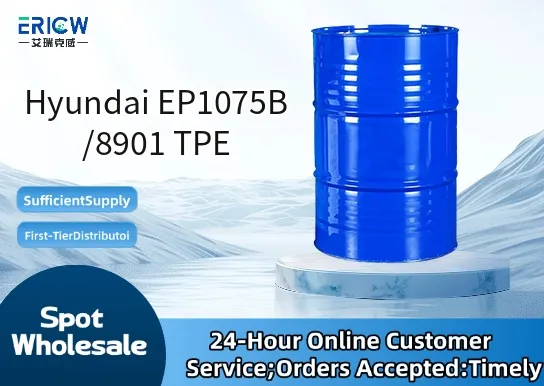
Q1: What is the primary application domain for Hyundai EP1075B/8901 TPE?
A: This thermoplastic elastomer is primarily engineered for soft-touch overmolding applications—especially on rigid substrates such as PP, ABS, and PC—common in automotive interior components, consumer electronics housings, and premium appliance grips.
Q2: Is Hyundai EP1075B/8901 TPE compatible with common injection molding equipment?
A: Yes—it processes reliably on standard injection molding machines using conventional screw configurations. Pre-drying is recommended at 60–80 °C for 2–4 hours to maintain optimal melt stability and surface quality.
Q3: How does this grade achieve adhesion to rigid thermoplastics?
A: It features a selectively balanced block copolymer architecture that promotes interfacial compatibility and mechanical anchoring—particularly with polyolefins and engineering resins—without requiring primers or surface activation in most standard overmolding conditions.
Q4: Can it be used in applications requiring skin-safe or low-extractables performance?
A: Hyundai EP1075B/8901 TPE is formulated without halogenated flame retardants, heavy metals, or known allergenic plasticizers. While not pre-certified for medical or food-contact use, its base composition supports formulation pathways toward skin-safe and low-odor requirements when processed under controlled conditions.
Q5: What are typical dosage guidelines when blending with other polymers?
A: As a functional modifier, it is typically used at low concentrations—generally ranging from 0.1% to 2% by weight—to enhance flexibility, impact resistance, or tactile properties in polymer blends, depending on the base resin and end-use performance targets.
Contact With Us:
E-mail: wangxingqiang@ericwchem.com
Have a Questions? Call Us:
Add:
Building A1, Jiete Industrial Park, Huangpu District, Guangzhou City, Guangdong Province, China