English
 Español
 tiếng việt
 русский
Excellent abrasion resistance for demanding mechanical environments.
Outstanding flexibility and low-temperature performance down to –30 °C.
Good oil, grease, and hydrocarbon resistance suitable for industrial contact.
High melt stability and consistent rheology for reliable extrusion and injection molding.
Transparent to translucent appearance with excellent clarity and UV stability.
Flexible tubing and hose for pneumatic and fluid transfer systems.
Protective covers and bellows for automotive and industrial actuators.
Wear-resistant components in material handling equipment.
Seals, gaskets, and dynamic sealing elements requiring elasticity and durability.
Overmolding substrates for ergonomic tool handles and medical device grips.
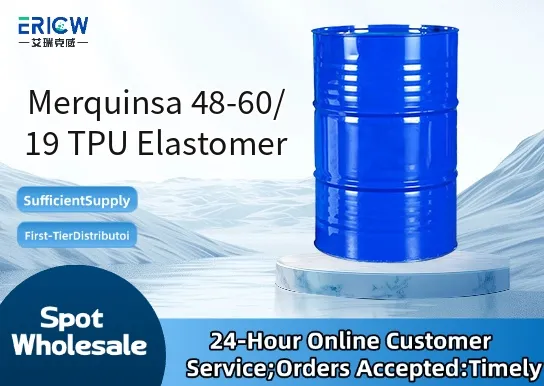
| Chemical Type | Thermoplastic Polyurethane (TPU), polyester-based |
| Product Form | Pellets |
| Appearance | Translucent, natural-colored granules |
| Shore A Hardness | 48–60 |
| Melt Flow Index (230 °C / 2.16 kg) | 19 g/10 min |
| Density | 1.18–1.22 g/cm³ |
| Processing Temperature Range | 180–220 °C |
| Key Features | High elasticity, excellent rebound, low compression set |
Q1: What is the primary chemical composition and structural class of Merquinsa 48-60/19?
A: Merquinsa 48-60/19 is a thermoplastic polyurethane (TPU) elastomer based on polyester chemistry, featuring a segmented copolymer structure with alternating hard segments (typically aromatic diisocyanate and chain extender) and soft segments (polyester diol). Its designation reflects its Shore A hardness range and key processing characteristics.
Q2: Is this TPU suitable for extrusion coating or calendering onto textiles and flexible substrates?
A: Yes — Merquinsa 48-60/19 is specifically engineered for melt-processing techniques including extrusion coating, film casting, and calendering. It offers excellent melt stability, good interfacial adhesion to common textile backings (e.g., polyester, nylon, and cotton blends), and balanced surface tack and release properties.
Q3: How does it perform under dynamic mechanical stress and low-temperature flexibility?
A: This grade delivers high elasticity retention and resilience across a broad service temperature range. It maintains good flexibility at sub-zero temperatures and exhibits strong resistance to repeated flexing, abrasion, and compression set — making it well-suited for demanding applications such as technical apparel, inflatable components, and protective films.
Q4: Can it be overmolded or co-extruded with other thermoplastics?
A: Merquinsa 48-60/19 shows good compatibility for co-processing with selected engineering thermoplastics such as ABS, PC, and certain polyesters, particularly when interfacial adhesion is enhanced via process optimization (e.g., controlled melt temperature, residence time, and substrate pretreatment). Compatibility should be verified case-by-case through adhesion testing.
Contact With Us:
E-mail: wangxingqiang@ericwchem.com
Have a Questions? Call Us:
Add:
Building A1, Jiete Industrial Park, Huangpu District, Guangzhou City, Guangdong Province, China