English
 Español
 tiếng việt
 русский
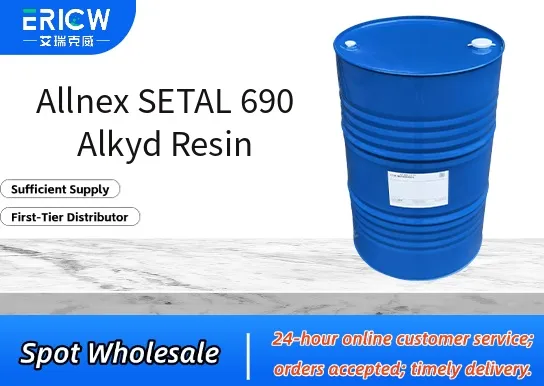
Medium-oil-length alkyd resin based on phthalic anhydride and glycerol for balanced drying and flexibility.
Designed for excellent compatibility with nitrocellulose, acrylics, and other common film formers.
Delivers good gloss retention and weather resistance in air-dry coatings.
Offers low viscosity for high-solids formulations without sacrificing film integrity.
Provides strong adhesion to metal, wood, and primed substrates.
General-purpose industrial maintenance coatings.
Original equipment manufacturer (OEM) finishes for agricultural and construction equipment.
Protective coatings for metal furniture and fencing.
Refinish coatings for automotive underhood components.
Decorative wood coatings for interior doors and moldings.
| Chemical Type | Phthalic-Glycerol Medium-Oil Alkyd |
| Product Form | Liquid resin solution |
| Appearance | Clear, pale yellow to amber liquid |
| Solvent | Xylene / Solvent naphtha blend |
| Solid Content (wt%) | 60 ± 2% |
| Viscosity (25°C, Gardner-Holdt) | ~Z4–Z5 |
| Acid Value (mg KOH/g) | 6–10 |
| Density (25°C, g/cm³) | 0.98–1.02 |
Q1: What is the primary application field for SETAL 690?
A: SETAL 690 is a medium-oil alkyd resin specifically designed for high-performance industrial maintenance and protective coatings, including metal primers, topcoats, and general-purpose enamels where good gloss retention, flexibility, and weather resistance are required.
Q2: Is SETAL 690 suitable for water-reducible systems?
A: Yes — SETAL 690 is formulated to be compatible with water-reducible alkyd technologies and can be used in solvent-borne or water-reducible hybrid systems, often requiring appropriate emulsifiers or co-solvents to achieve stable dispersion.
Q3: How does SETAL 690 compare to long-oil alkyds in terms of drying and film hardness?
A: As a medium-oil alkyd, SETAL 690 offers a balanced profile: faster through-dry and higher initial hardness than long-oil variants, while retaining better flexibility and compatibility with reactive diluents or crosslinkers than short-oil resins.
Q4: Can SETAL 690 be modified or crosslinked with other resins?
A: Yes — SETAL 690 exhibits good compatibility with amino resins (e.g., melamine-formaldehyde), isocyanates, and polyisocyanate crosslinkers, enabling thermosetting formulations with enhanced chemical resistance and mechanical performance.
Q5: What solvents are typically recommended for dissolving or diluting SETAL 690?
A: SETAL 690 dissolves readily in common aromatic and aliphatic hydrocarbon solvents such as xylene, Solvesso™ 100, and high-flash naphthas; it also shows good compatibility with ester and ketone solvents when formulating low-VOC or high-solids systems.
Contact With Us:
E-mail: wangxingqiang@ericwchem.com
Have a Questions? Call Us:
Add:
Building A1, Jiete Industrial Park, Huangpu District, Guangzhou City, Guangdong Province, China