English
 Español
 tiếng việt
 русский
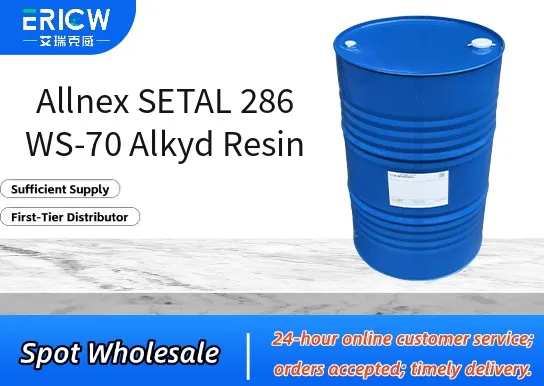
Water-reducible alkyd resin enabling low-VOC, high-performance coatings without co-solvents.
Excellent gloss retention and film hardness development after ambient cure.
Good compatibility with acrylic emulsions and waterborne crosslinkers for hybrid systems.
Stable in neutral to slightly alkaline pH range (7.5–9.0), supporting broad formulation flexibility.
Low yellowing tendency, suitable for white and pastel architectural and industrial finishes.
Waterborne architectural trim and woodwork paints.
Interior and exterior maintenance coatings for metal and wood substrates.
Low-VOC industrial maintenance coatings for agricultural and construction equipment.
Hybrid waterborne topcoats requiring alkyd-like aesthetics and durability.
DIY and professional-grade waterborne enamel replacements.
| Chemical Type | Water-reducible alkyd resin (soy-oil modified) |
| Product Form | Opaque white to off-white aqueous dispersion |
| Appearance | Homogeneous liquid, slight opalescence |
| Non-Volatile Content (NV%) | 70 ± 1 wt% |
| pH (at 25°C) | 8.0–8.5 |
| Viscosity (Brookfield RVT, spindle #3, 20 rpm, 25°C) | 150–400 mPa·s |
| Particle Size (D50) | 120–200 nm |
| Primary Applications | Waterborne decorative and maintenance coatings |
Q1: What is the primary application area for SETAL 286 WS-70?
A: SETAL 286 WS-70 is a water-reducible alkyd resin designed primarily for high-performance, low-VOC decorative and protective coatings, including interior and exterior architectural paints, wood finishes, and maintenance coatings where good gloss retention, flow, and substrate wetting are required.
Q2: How is SETAL 286 WS-70 typically incorporated into waterborne formulations?
A: It is commonly added during the let-down stage of waterborne acrylic or hybrid systems, often after neutralization with amines such as AMP-95 or DMEA. Good dispersion and gentle mixing are recommended to avoid foam generation and ensure stable emulsion formation.
Q3: Does SETAL 286 WS-70 require coalescing agents or other film-forming aids?
A: While it contributes inherent film-forming capability due to its alkyd backbone, optimal film formation in low-temperature or high-humidity conditions may benefit from compatible coalescents—selection should be based on compatibility testing within the full formulation.
Q4: Can SETAL 286 WS-70 be used in direct-to-metal (DTM) applications?
A: Yes—it is frequently employed in waterborne DTM coatings where enhanced adhesion, corrosion inhibition synergy (when combined with appropriate pigments and inhibitors), and flexibility are desired; however, full system validation under relevant exposure conditions is essential.
Q5: Is SETAL 286 WS-70 compatible with common rheology modifiers and biocides?
A: It demonstrates broad compatibility with associative and non-associative thickeners (e.g., HEC, HASE, HEUR types) and standard isothiazolinone-based preservatives, though compatibility should always be confirmed through practical formulation trials to ensure long-term stability and performance.
Contact With Us:
E-mail: wangxingqiang@ericwchem.com
Have a Questions? Call Us:
Add:
Building A1, Jiete Industrial Park, Huangpu District, Guangzhou City, Guangdong Province, China