English
 Español
 tiếng việt
 русский
High thermal stability up to 800 °C, suitable for high-temperature ceramic and enamel applications.
Excellent chemical resistance against acids, alkalis, and solvents in industrial coating systems.
Consistent chromaticity and batch-to-batch color reproducibility certified per ISO 9001 manufacturing standards.
Non-toxic formulation compliant with EN 71-3 and RoHS Directive for safe handling and end-use.
Optimized particle size distribution for enhanced dispersion stability in aqueous and solvent-based media.
Ceramic glazes and underglaze decorations for tableware and architectural tiles.
High-performance industrial coatings for automotive OEM and refinish applications.
Fire-resistant intumescent paints and passive fire protection systems.
Colored glass formulations for architectural and decorative glass products.
Plastic coloration for engineering thermoplastics requiring long-term UV and heat resistance.
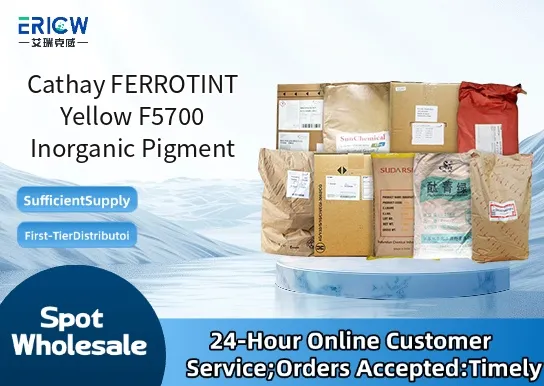
| Chemical Type | Complex iron oxide-based inorganic pigment (Fe-Zn-Cr spinel structure) |
| Product Form | Fine dry powder |
| Appearance | Brilliant yellow to yellow-orange free-flowing powder |
| Primary Applications | Ceramics, industrial coatings, colored glass, fireproofing materials |
| Key Features | Heat stability, lightfastness (ASTM D4303 Class 1), non-volatile |
| Benefits | No heavy metals, low dust generation, compatible with standard dispersing equipment |
| Density (g/cm³) | 4.2–4.5 |
| pH (10% aqueous slurry) | 6.8–7.4 |
Q1: What is the primary chemical composition of Cathay FERROTINT Yellow F5700?
A: Cathay FERROTINT Yellow F5700 is an iron oxide-based inorganic pigment, primarily composed of hydrated iron(III) oxide with controlled crystallinity and particle morphology to deliver consistent yellow hue and high thermal stability.
Q2: Is this pigment suitable for use in food-contact plastics or coatings?
A: Cathay FERROTINT Yellow F5700 is designed for general industrial applications and is not certified for direct food-contact use. For food-safe applications, consult regulatory documentation and verify compliance with applicable regional requirements before use.
Q3: How does F5700 perform under high-temperature processing conditions?
A: As a thermally stable inorganic pigment, F5700 maintains its color integrity during standard polymer processing—including injection molding and extrusion—at temperatures up to approximately 300 °C, without significant discoloration or decomposition.
Q4: What dispersion methods are recommended for optimal performance in solvent-based systems?
A: For solvent-based coatings and inks, effective dispersion is typically achieved using high-shear mixing or bead milling with compatible wetting agents. Pre-dispersed pastes or surface-treated grades may further enhance stability and color development.
Q5: Can F5700 be used alongside organic pigments or other inorganic pigments in multi-pigment formulations?
A: Yes—F5700 exhibits good compatibility with many common organic pigments and inorganic pigments. However, formulation stability and potential interactions (e.g., flocculation or chromatic shift) should be evaluated through lab-scale trials under intended application conditions.
Contact With Us:
E-mail: wangxingqiang@ericwchem.com
Have a Questions? Call Us:
Add:
Building A1, Jiete Industrial Park, Huangpu District, Guangzhou City, Guangdong Province, China