English
 Español
 tiếng việt
 русский
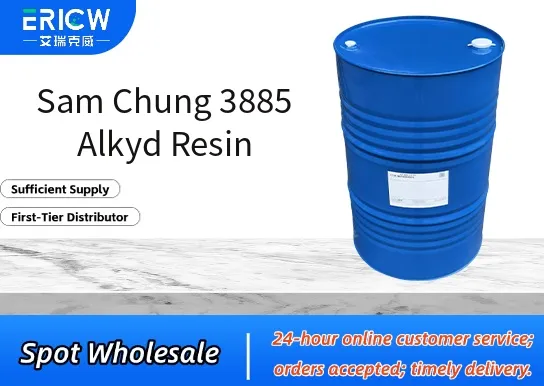
Medium-oil-length alkyd resin offering balanced drying speed and film flexibility.
Excellent compatibility with nitrocellulose, PVC, and common solvent-based resins.
Provides superior gloss retention and color stability under ambient curing conditions.
Low viscosity enables easy formulation into high-solids coatings without excessive thinning.
Designed for ambient-cure applications with good through-dry and sandability.
General-purpose air-drying decorative enamels for metal furniture and fixtures.
Industrial maintenance coatings for agricultural and construction equipment.
Undercoats and primers requiring adhesion to ferrous and non-ferrous substrates.
Wood finishing systems including interior trim, cabinetry, and door coatings.
Refinish coatings for automotive touch-up and non-OEM industrial repair.
| Chemical Type | Medium-oil modified phthalic alkyd resin |
| Product Form | Liquid, solvent-borne (xylene/toluene blend) |
| Appearance | Clear to pale yellow viscous liquid |
| Non-Volatile Content (wt%) | ~60–62% |
| Viscosity (25°C, Brookfield RVT, #4 spindle, 20 rpm) | 8,000–12,000 cP |
| Acid Value (mg KOH/g) | 6–9 |
| Density (25°C, g/cm³) | 0.98–1.02 |
| Primary Applications | Air-drying enamel coatings, primers, and undercoats |
Q1: What is the primary application field for Sam Chung 3885 Alkyd Resin?
A: Sam Chung 3885 is a medium-oil-length alkyd resin designed primarily for solvent-based industrial maintenance coatings, general-purpose enamels, and decorative architectural finishes where balanced drying speed, gloss retention, and film flexibility are required.
Q2: Is Sam Chung 3885 compatible with common crosslinkers such as melamine-formaldehyde resins or isocyanates?
A: Yes — it exhibits good compatibility with amino resins (e.g., melamine-formaldehyde) in baked systems and can be formulated with polyisocyanates in two-component polyurethane-modified alkyd systems, subject to proper catalyst selection and cure schedule optimization.
Q3: How does Sam Chung 3885 perform in terms of outdoor weather resistance compared to long-oil alkyds?
A: As a medium-oil alkyd, it offers improved hardness and chemical resistance over long-oil variants, though UV stability and chalk resistance are moderate; for enhanced exterior durability, co-formulation with UV absorbers or hybridization with acrylic monomers is commonly employed.
Q4: Can Sam Chung 3885 be used in high-solids coating formulations?
A: Yes — its viscosity profile and molecular architecture support high-solids applications when blended with reactive diluents or low-viscosity solvents; formulation adjustments may be needed to maintain sprayability and film formation without excessive solvent use.
Q5: What solvent types are typically recommended for dissolving or thinning Sam Chung 3885?
A: It dissolves readily in common aromatic and ketonic solvents such as xylene, toluene, methyl ethyl ketone (MEK), and methyl isobutyl ketone (MIBK); ester solvents like butyl acetate may also be used depending on volatility and evaporation rate requirements.
Contact With Us:
E-mail: wangxingqiang@ericwchem.com
Have a Questions? Call Us:
Add:
Building A1, Jiete Industrial Park, Huangpu District, Guangzhou City, Guangdong Province, China