English
 Español
 tiếng việt
 русский
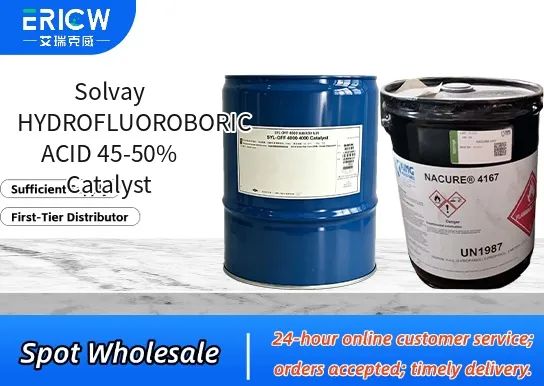
Highly controlled concentration (45–50% w/w) ensures consistent catalytic performance and reproducible reaction outcomes.
Optimized purity profile with low metal impurities, minimizing unwanted side reactions in sensitive fluorination processes.
Stabilized formulation for enhanced shelf life and reduced decomposition risk during storage and handling.
Engineered for precise stoichiometric control in Lewis acid-catalyzed transformations, improving yield and selectivity.
Compatible with standard industrial stainless steel (316 SS) and fluoropolymer-lined equipment under recommended operating conditions.
Catalysis of aromatic and aliphatic fluorination reactions in pharmaceutical intermediate synthesis.
Facilitation of selective C–F bond formation in agrochemical active ingredient manufacturing.
Activation of silicon-based reagents in silicone polymer crosslinking and functionalization.
Use as a co-catalyst in Friedel–Crafts acylation and alkylation reactions requiring mild Lewis acidity.
Enabling fluorosilane production for surface modification of glass, ceramics, and electronic substrates.
| Chemical Type | Hydrofluoroboric acid solution (H₂BF₄) |
| Product Form | Liquid, aqueous solution |
| Appearance | Clear, colorless to pale yellow liquid |
| Concentration Range | 45–50% w/w H₂BF₄ in water |
| Primary Applications | Fluorination catalysis, Lewis acid-mediated synthesis |
| Key Features | Controlled acidity, low chloride and sulfate content |
| Storage Conditions | Store at 15–25°C in tightly sealed polyethylene or fluoropolymer containers |
| Handling Recommendation | Use in well-ventilated areas with chemical-resistant PPE (gloves, goggles, face shield) |
Q1: What is the primary function of Solvay HYDROFLUOROBORIC ACID 45–50% in industrial catalysis?
A: It serves as a highly effective fluorinating and boronating catalyst, particularly in specialty organic synthesis and high-performance polymerization processes where controlled Lewis acidity and fluoride ion delivery are required.
Q2: How should this product be handled and stored to maintain stability and performance?
A: Store in tightly sealed, corrosion-resistant containers (e.g., polyethylene or fluoropolymer-lined) under dry, cool conditions away from moisture, strong oxidizers, and incompatible metals. Always handle using appropriate PPE—including chemical-resistant gloves, goggles, and ventilation—due to its corrosive and moisture-sensitive nature.
Q3: Is Solvay HYDROFLUOROBORIC ACID 45–50% compatible with common solvents used in catalytic formulations?
A: It demonstrates good compatibility with anhydrous polar aprotic solvents such as acetonitrile, dichloromethane, and chlorobenzene. Avoid protic solvents (e.g., water, alcohols) and strongly basic media, which may cause rapid decomposition or loss of catalytic activity.
Q4: What safety precautions are critical when integrating this catalyst into a production process?
A: Strict engineering controls—including closed-system transfer, local exhaust ventilation, and real-time HF vapor monitoring—are recommended. Personnel must be trained in emergency response for acid exposure, and neutralization protocols for spills should follow site-specific hazardous materials management plans.
Contact With Us:
E-mail: wangxingqiang@ericwchem.com
Have a Questions? Call Us:
Add:
Building A1, Jiete Industrial Park, Huangpu District, Guangzhou City, Guangdong Province, China