English
 Español
 tiếng việt
 русский
High reactivity with epoxy resins enabling rapid room-temperature cure.
Excellent chemical resistance post-cure, particularly to solvents and weak acids.
Low viscosity for easy handling, precise metering, and homogeneous mixing.
Good adhesion to metals, composites, and cured epoxy substrates.
Low volatility and non-hazardous classification under GHS for safe industrial handling.
Structural adhesives for automotive bonding and assembly.
Electrical encapsulation and potting compounds in power electronics.
Composite matrix systems for wind turbine blade manufacturing.
Repair mortars and high-performance flooring systems.
Tooling and mold-making materials requiring dimensional stability.
| Chemical Type | Amine-based aliphatic curing agent |
| Product Form | Liquid |
| Appearance | Clear, pale yellow liquid |
| Density (20 °C) | 0.92–0.94 g/cm³ |
| Viscosity (25 °C) | 180–220 mPa·s |
| Amine Value | 390–410 mg KOH/g |
| Primary Applications | Epoxy resin curing for structural adhesives and composites |
| Storage Stability | ≥12 months at 15–25 °C in sealed containers |
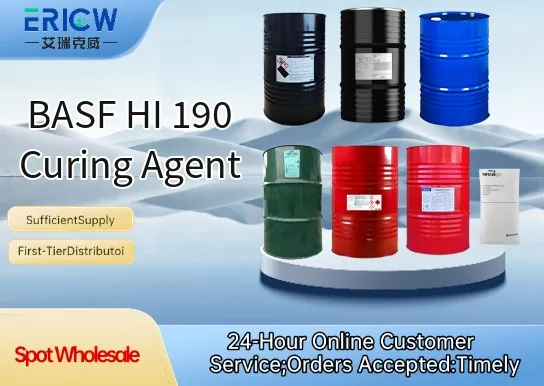
Q1: What is the primary function of BASF HI 190 Curing Agent in epoxy systems?
A: BASF HI 190 is a latent, amine-based curing agent designed to provide controlled reactivity and extended pot life in one-component epoxy formulations. It enables thermal activation for crosslinking, supporting high-performance coatings, adhesives, and composites requiring good storage stability and precise cure scheduling.
Q2: How does HI 190 compare to conventional aromatic amine hardeners in terms of handling and safety?
A: Unlike many aromatic amines, HI 190 exhibits lower volatility and reduced skin sensitization potential due to its blocked chemical structure. It is non-volatile at ambient temperatures and generally easier to handle in industrial settings—though standard PPE (gloves, eye protection) and good ventilation are still recommended during processing.
Q3: What is the typical activation temperature range for full cure with HI 190?
A: Full crosslinking typically initiates above 120 °C and proceeds efficiently within the 140–180 °C range, depending on formulation composition and desired cure speed. Lower-temperature post-cures may be possible with extended dwell times, but optimal performance is achieved within this thermal window.
Q4: Can HI 190 be used in solvent-free or high-solids epoxy systems?
A: Yes, HI 190 is compatible with low-VOC and solvent-free epoxy resins. Its solid form and low melt viscosity facilitate uniform dispersion without requiring aggressive solvents, making it suitable for environmentally conscious coating and composite applications where volatile content must be minimized.
Q5: Is HI 190 compatible with common epoxy resin types such as DGEBA, NOVOLAC, and cycloaliphatic epoxies?
A: HI 190 demonstrates broad compatibility with standard diglycidyl ether of bisphenol-A (DGEBA), epoxy novolacs, and many cycloaliphatic epoxies. Performance optimization—including gel time, glass transition temperature, and mechanical properties—requires formulation-specific adjustment and empirical validation.
Contact With Us:
E-mail: wangxingqiang@ericwchem.com
Have a Questions? Call Us:
Add:
Building A1, Jiete Industrial Park, Huangpu District, Guangzhou City, Guangdong Province, China