English
 Español
 tiếng việt
 русский
High chromatic strength and excellent tinting power in both organic and aqueous systems.
Outstanding thermal stability up to 220°C, suitable for medium-temperature processing.
Good lightfastness (ASTM Level 7) and weather resistance in protected applications.
Low water solubility and superior migration resistance in PVC, polyolefin, and ABS compounds.
Consistent particle size distribution ensuring uniform dispersion and minimal filter clogging.
Coloration of rigid and flexible PVC profiles, sheets, and flooring.
Masterbatch formulation for polypropylene (PP) and high-density polyethylene (HDPE) packaging films.
Automotive interior plastics requiring non-blooming, heat-stable yellow hues.
Industrial coatings for metal and plastic substrates where solvent resistance is critical.
Engineering thermoplastics including ABS and polycarbonate blends for consumer electronics housings.
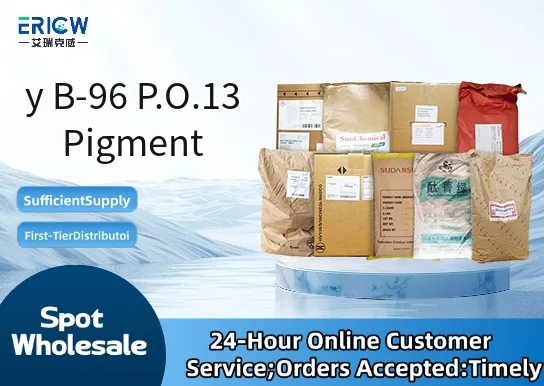
| Chemical Type | Azo pigment (Pigment Orange 13) |
| Product Form | Fine dry powder |
| Appearance | Orange-red free-flowing powder |
| Primary Applications | Polymer coloration, industrial coatings, masterbatches |
| Key Features | Heat stability, low volatility, high opacity |
| Benefits | Reduced dosage requirement, consistent batch-to-batch color match |
| pH Value (5% aqueous slurry) | 6.5 – 7.5 |
| Volatile Matter (105°C, 2h) | ≤ 0.5% |
Q1: What is the primary chemical class and typical hue profile of y B-96 P.O.13 Pigment?
A: y B-96 P.O.13 is an organic pigment belonging to the monoazo pyridone chemical family, offering a clean, high-strength orange shade with excellent brightness and moderate bluish undertone—commonly selected for applications requiring chromatic precision and lightfastness.
Q2: Is y B-96 P.O.13 suitable for use in food-contact plastics or packaging films?
A: This pigment is not pre-approved for direct food-contact applications under major global regulatory frameworks; it may be considered for non-migrating, barrier-layered packaging systems where regulatory assessment by the end-user is required prior to commercial use.
Q3: How does y B-96 P.O.13 perform in polyolefin masterbatches under high-temperature processing conditions?
A: It demonstrates good thermal stability in polyolefin systems up to typical extrusion temperatures (≤240 °C), maintaining color integrity and minimal degradation—making it well-suited for PP and HDPE masterbatch formulations when properly dispersed.
Q4: What dispersion methods are recommended to achieve optimal color development and gloss in solvent-based coatings?
A: High-shear dispersing using media mills or three-roll mills is recommended; compatibility with common coating resins (e.g., acrylics, alkyds, and polyester-based systems) supports uniform distribution and enhances both tinting strength and surface gloss.
Contact With Us:
E-mail: wangxingqiang@ericwchem.com
Have a Questions? Call Us:
Add:
Building A1, Jiete Industrial Park, Huangpu District, Guangzhou City, Guangdong Province, China