English
 Español
 tiếng việt
 русский
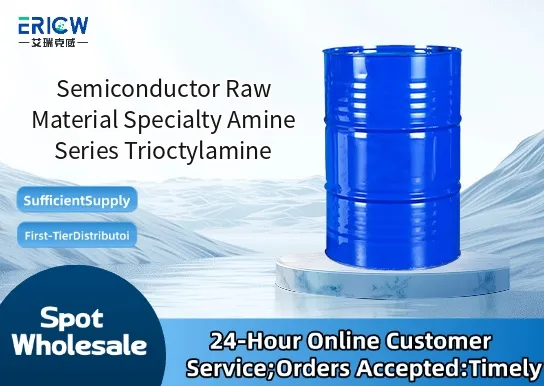
Ultra-low metal impurity profile (<10 ppb total metals), critical for high-purity semiconductor process chemistry.
High chemical stability under inert atmosphere and controlled temperature, minimizing decomposition during storage and handling.
Controlled amine basicity (pKb ≈ 3.8) enabling selective coordination with transition metal precursors in CVD/ALD precursor synthesis.
Low volatility and negligible vapor pressure at room temperature, supporting safe handling in Class 100 cleanroom environments.
Batch-to-batch consistency verified via GC-MS, NMR, and ICP-MS analytical certification per lot.
Synthesis of high-purity metal–amine complexes for atomic layer deposition (ALD) of metal nitride barriers (e.g., TaN, TiN).
Stabilizing ligand in solution-phase preparation of colloidal metal nanoparticles for advanced interconnect metallization.
Complexing agent in solvent extraction processes for ultra-trace metal purification (e.g., removal of Fe, Ni, Cu from high-k dielectric precursors).
Reaction moderator in low-temperature thermal decomposition of metal–organic precursors to reduce carbon residue in thin films.
Functional additive in photoresist formulation development for improved adhesion and defect control on Si/SiO₂ substrates.
| Chemical Type | Tertiary amine, trialkylamine derivative |
| Product Form | Pale yellow to colorless liquid |
| Appearance | Clear, homogeneous, free of suspended particles or phase separation |
| Melting Point | −25 °C (typical) |
| Boiling Point (at 760 mmHg) | 365–370 °C |
| Primary Applications | Ligand in semiconductor precursor synthesis; metal ion sequestration; ALD/CVD process additive |
| Key Features | Ultra-high purity (≥99.99% GC), low residual moisture (<50 ppm), low chloride (<1 ppm) |
| Regulatory Compliance | REACH compliant; RoHS 2.0 conformant; no SVHCs listed in current Candidate List |
| Common Compatible Systems | Suitability |
| Anhydrous toluene / heptane solvent systems | Highly Recommended – Fully miscible; maintains chemical integrity under N₂ blanket |
| Organometallic precursor solutions (e.g., Ta(NMe₂)₅, Ti(OiPr)₄) | Highly Recommended – Forms stable adducts without premature decomposition |
| Stainless steel (316L) and electropolished Hastelloy® C-276 fluidic systems | Recommended – No measurable leaching or corrosion observed at <40 °C |
| Quartz and fused silica reactor components | Suitable – Chemically inert; no detectable interaction under standard ALD conditions |
Q1: What is the CAS Registry Number for Trioctylamine used in semiconductor applications?
A: The CAS number is 1116-76-3. Our semiconductor-grade material is purified to remove isomeric impurities (e.g., trihexylamine, tetraoctylammonium salts) and rigorously tested for trace elemental contaminants.
Q2: What is the typical recommended dosage when using Trioctylamine as a ligand in metal precursor synthesis?
A: Dosage is application-specific; common molar ratios range from 1.2:1 to 3:1 (Trioctylamine : metal center). Optimization requires empirical evaluation under inert conditions — we provide technical support for stoichiometric screening protocols.
Q3: How does semiconductor-grade Trioctylamine differ from commercial-grade or reagent-grade amine?
A: Semiconductor-grade Trioctylamine undergoes multi-step fractional distillation under vacuum, followed by chelation-assisted metal scavenging and 0.1 µm PTFE filtration. It meets strict limits for Na, K, Fe, Ni, Cr, Al, and Cl (all <10 ppb by ICP-MS), unlike general-purpose grades.
Q4: Is Trioctylamine subject to migration or leaching in wafer-level processing equipment?
A: No significant migration occurs under standard ALD/CVD conditions (≤300 °C, ≤10 Torr). Thermal gravimetric analysis (TGA) shows <0.5 wt% mass loss below 350 °C; residual amine is fully volatilized during post-deposition annealing and poses no film contamination risk.
Contact With Us:
E-mail: wangxingqiang@ericwchem.com
Have a Questions? Call Us:
Add:
Building A1, Jiete Industrial Park, Huangpu District, Guangzhou City, Guangdong Province, China