English
 Español
 tiếng việt
 русский
High thermal stability suitable for processing temperatures up to 1200 °C.
Excellent chemical resistance to acids, alkalis, and solvents in demanding industrial environments.
Non-toxic formulation compliant with global regulatory frameworks including REACH and RoHS.
Consistent particle size distribution ensuring uniform dispersion and color strength.
UV-resistant performance with minimal fading under prolonged outdoor exposure.
Ceramic glazes and bodies for tableware, sanitaryware, and architectural tiles.
High-performance refractory coatings used in kiln furniture and furnace linings.
Coloration of technical glass, including borosilicate and aluminosilicate compositions.
Pigmentation of inorganic binders in fire-resistant construction materials.
Specialty enamels for metal substrates requiring high-temperature durability.
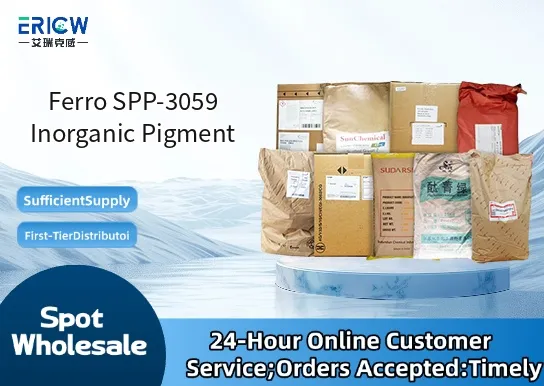
| Chemical Type | Mixed-metal oxide (chromium-iron spinel based) |
| Product Form | Fine dry powder |
| Appearance | Dark green to black granular powder |
| Primary Applications | Ceramics, refractories, technical glass, enamels |
| Key Features | Thermal stability, chemical inertness, non-volatility |
| Benefits | Color consistency at high firing temperatures, low migration risk |
| pH (10% aqueous slurry) | 6.5–8.0 |
| Moisture Content (max) | 0.5 wt% |
Q1: What is the primary chemical composition of Ferro SPP-3059?
A: Ferro SPP-3059 is a high-performance inorganic pigment based on a complex metal oxide system, engineered for thermal and chemical stability. Its exact formulation is proprietary, but it contains no heavy metals regulated under RoHS or REACH SVHC criteria at levels of concern.
Q2: Is SPP-3059 suitable for use in food-contact plastics?
A: Yes — SPP-3059 is designed for applications requiring compliance with global food-contact regulations. It has been evaluated for extractable metal content and demonstrates low migration potential in polyolefins and engineering thermoplastics under typical processing and end-use conditions.
Q3: How does SPP-3059 perform under high-temperature processing?
A: SPP-3059 exhibits excellent thermal stability, retaining color integrity and dispersion quality during extrusion, injection molding, and compounding processes up to 300 °C. It shows minimal color shift or decomposition even under extended residence times in high-shear equipment.
Q4: What types of polymer systems is SPP-3059 most commonly used in?
A: SPP-3059 is widely compatible with polyolefins (PP, HDPE, LDPE), polyesters (PET, PBT), polycarbonate, and engineering thermoplastics. It delivers consistent dispersion and color development without adversely affecting mechanical properties or melt rheology.
Q5: What is the typical dosage range for optimal coloration?
A: Dosage depends on the desired shade intensity and base polymer, but SPP-3059 is typically used at low concentrations — generally ranging from 0.1% to 2% by weight — due to its high tinting strength and efficient light absorption characteristics.
Contact With Us:
E-mail: wangxingqiang@ericwchem.com
Have a Questions? Call Us:
Add:
Building A1, Jiete Industrial Park, Huangpu District, Guangzhou City, Guangdong Province, China