English
 Español
 tiếng việt
 русский
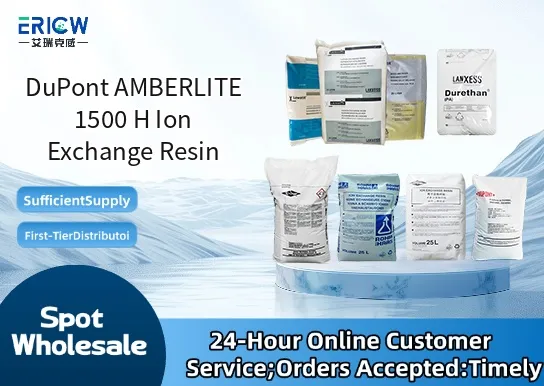
High-capacity strong acid cation exchange resin in hydrogen form, optimized for efficient demineralization.
Uniform spherical beads with excellent physical stability and low fines generation during service cycles.
Superior chemical resistance to oxidation and osmotic shock, ensuring long operational life in demanding environments.
Consistent particle size distribution enabling low pressure drop and high flow rate capability in packed-bed systems.
Low sodium leakage and high regeneration efficiency, supporting stringent water purity requirements.
Primary cation exchanger in mixed-bed and two-bed demineralization systems for ultrapure water production.
Softening and dealkalization of industrial process water in power generation and microelectronics manufacturing.
Pre-treatment for reverse osmosis (RO) feed water to protect membranes from hardness scaling.
Catalytic support and pH adjustment in pharmaceutical-grade water purification systems.
Removal of heavy metal cations (e.g., Cu²⁺, Ni²⁺, Zn²⁺) from metal finishing rinse waters.
| Chemical Type | Strong acid cation exchange resin (sulfonic acid functional group) |
| Product Form | Hydrogen form (H⁺) |
| Appearance | Uniform amber-colored spherical beads |
| Functional Group | Sulfonic acid (–SO₃H) |
| Matrix Structure | Styrene-divinylbenzene copolymer |
| Ion Exchange Capacity (min.) | 2.0 eq/L (dry basis) |
| Moisture Content | 45–50% (as shipped) |
| Particle Size Range | 0.3–1.2 mm (95% retained on 16 mesh, passes 50 mesh) |
Q1: What is the primary functional form of AMBERLITE 1500 H resin?
A: AMBERLITE 1500 H is supplied in the hydrogen (H⁺) form and is a strong acid cation exchange resin based on a sulfonated polystyrene-divinylbenzene matrix. It is designed for applications requiring efficient removal of cations such as calcium, magnesium, sodium, and heavy metals from aqueous streams.
Q2: Can AMBERLITE 1500 H be used in food-grade or pharmaceutical water purification systems?
A: Yes — AMBERLITE 1500 H is manufactured and tested to meet requirements for use in water purification systems intended for food, beverage, and pharmaceutical applications, provided it is operated within validated process parameters and regenerated using food-grade regenerants (e.g., hydrochloric acid).
Q3: How does AMBERLITE 1500 H compare to gel-type resins in terms of physical stability and kinetics?
A: AMBERLITE 1500 H features a macroporous structure, offering superior physical stability under repeated swelling/shrinking cycles and improved resistance to fouling compared to conventional gel-type resins. Its macroporosity also supports faster ion exchange kinetics, especially in solutions with high organic content or suspended solids.
Q4: What regeneration chemicals are recommended for AMBERLITE 1500 H?
A: Hydrochloric acid (HCl) is the standard regenerant for restoring the resin to the H⁺ form. Sulfuric acid may also be used, though care must be taken to avoid calcium sulfate precipitation in hard water applications. Regeneration efficiency depends on acid concentration, contact time, and flow rate — typical practice uses low-to-moderate acid dosages with controlled rinse protocols.
Contact With Us:
E-mail: wangxingqiang@ericwchem.com
Have a Questions? Call Us:
Add:
Building A1, Jiete Industrial Park, Huangpu District, Guangzhou City, Guangdong Province, China