English
 Español
 tiếng việt
 русский
Highly selective for nickel (Ni²⁺) and cobalt (Co²⁺) ions in complex multi-metal leach solutions.
Exceptional chemical and osmotic stability in acidic environments, including sulfate and chloride media.
Optimized kinetic performance with rapid adsorption/desorption cycles for efficient metal recovery operations.
Low fines generation and excellent physical integrity after repeated regeneration cycles.
Designed for high-capacity operation with minimal pressure drop in large-scale fixed-bed columns.
Primary recovery of nickel and cobalt from laterite ore hydrometallurgical leachates.
Purification of electrolyte solutions prior to electrowinning in battery-grade metal production.
Removal of trace transition metals from spent lithium-ion battery leach liquors.
Selective separation of Ni/Co from mixed-metal streams in recycling and secondary raw material processing.
| Chemical Type | Chelating polyacrylic resin with iminodiacetate functional groups |
| Product Form | Moist, spherical beads |
| Appearance | Light yellow to amber, uniform spherical particles |
| Functional Group | Iminodiacetic acid (IDA) |
| Ion Form | Sodium form (Na⁺), ready for acid conversion |
| Particle Size Range | 0.3–1.2 mm (standard grade) |
| Moisture Content | Approx. 48–52% (as shipped) |
| Maximum Operating Temperature | 60 °C |
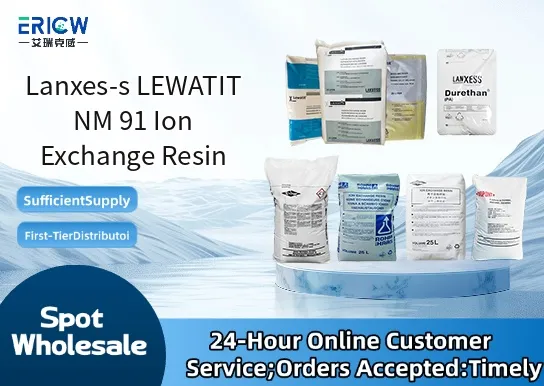
Q1: What is the primary functional group and ionic form of LANXESS LEWATIT NM 91?
A: LEWATIT NM 91 is a strongly acidic cation exchange resin based on a styrene-divinylbenzene matrix, functionalized with sulfonic acid groups. It is supplied in the sodium (Na⁺) form, making it suitable for softening and selective cation removal applications.
Q2: Is LEWATIT NM 91 suitable for food-grade or pharmaceutical water treatment?
A: Yes — LEWATIT NM 91 is manufactured and tested to meet requirements for use in the production of potable water and process water in food and pharmaceutical industries. It complies with relevant global regulatory expectations for ion exchange resins intended for indirect contact with consumables, subject to proper regeneration and operational validation.
Q3: How does NM 91 differ from standard gel-type strong acid cation resins in terms of selectivity and kinetics?
A: NM 91 features a macroporous structure, which provides enhanced kinetic performance and superior stability under variable operating conditions — including fluctuating flow rates, temperature shifts, or feed streams containing organic fouling potential. Its selectivity for multivalent cations (e.g., Ca²⁺, Mg²⁺) remains high, while offering improved resistance to osmotic shock and compaction compared to conventional gel-type resins.
Q4: What regeneration chemicals and typical conditions are recommended for LEWATIT NM 91?
A: Sodium chloride (NaCl) is the standard regenerant for softening service. Regeneration efficiency is optimized using 8–12% NaCl solution at ambient temperature, with typical dosage ranging from 100–150 g NaCl per liter of resin. Acid regeneration (e.g., HCl or H₂SO₄) may be applied for hydrogen-form operation, depending on application requirements.
Contact With Us:
E-mail: wangxingqiang@ericwchem.com
Have a Questions? Call Us:
Add:
Building A1, Jiete Industrial Park, Huangpu District, Guangzhou City, Guangdong Province, China