English
 Español
 tiếng việt
 русский
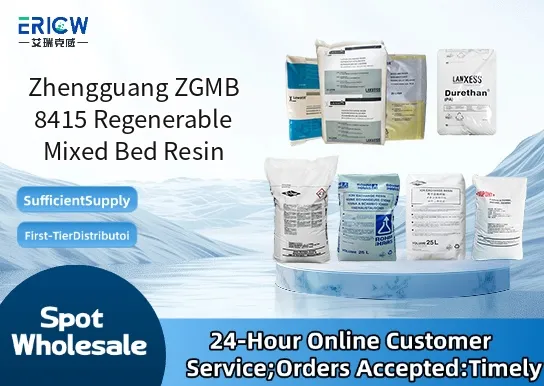
Highly regenerable cationic and anionic exchange resins pre-mixed in optimal ratio for consistent deionization performance.
Engineered for low sodium leakage and ultra-low silica breakthrough, meeting stringent ultrapure water (UPW) requirements.
Superior physical stability with high abrasion resistance and minimal fines generation during repeated regeneration cycles.
Compatible with standard strong acid–strong base regeneration protocols using HCl and NaOH without resin degradation.
Low total organic carbon (TOC) extractables, minimizing post-treatment contamination risk in sensitive processes.
Final polishing stage in pharmaceutical-grade purified water (PW) and water-for-injection (WFI) systems.
Ultraclean rinse water production for semiconductor wafer fabrication and flat-panel display manufacturing.
Power plant boiler feedwater polishing to prevent scaling and corrosion in high-pressure steam cycles.
Electronics manufacturing process water requiring resistivity >18.0 MΩ·cm at 25°C.
Laboratory and analytical instrument feedwater systems demanding consistent ionic purity and low conductivity.
| Chemical Type | Strong acid cation (H⁺ form) / Strong base anion (OH⁻ form) mixed bed |
| Product Form | Uniform spherical beads, pre-mixed and pre-conditioned |
| Appearance | Opaque off-white (cation) and amber (anion) beads, visually homogeneous blend |
| Primary Applications | Polishing of reverse osmosis permeate or electrodeionization (EDI) product water |
| Key Features | Regenerable, low leachable TOC, high exchange capacity, excellent hydraulic uniformity |
| Benefits | Extended service cycle life, reduced chemical consumption per regeneration, minimized downtime |
| Storage Conditions | Store dry at 5–40°C; avoid freezing and direct sunlight |
| Minimum Shelf Life | 24 months from date of manufacture when stored as specified |
Q1: What is the primary application of ZGMB 8415 in water purification systems?
A: ZGMB 8415 is specifically engineered for high-purity water production in mixed bed deionization units, commonly used in power generation, semiconductor manufacturing, pharmaceutical water systems, and laboratory-grade water purification where consistent low-conductivity effluent is critical.
Q2: Can ZGMB 8415 be regenerated on-site, and what regeneration chemicals are required?
A: Yes, ZGMB 8415 is designed for full on-site regeneration using standard strong acid (e.g., hydrochloric acid) and strong base (e.g., sodium hydroxide) solutions. Its robust bead structure and optimized cation/anion resin ratio support multiple regeneration cycles while maintaining separation efficiency and low rinse water demand.
Q3: How does ZGMB 8415 differ from non-regenerable mixed bed resins?
A: Unlike single-use mixed bed resins, ZGMB 8415 features enhanced crosslinking and uniform particle morphology to withstand repeated chemical regeneration without significant fines generation or bed compaction. This extends service life, reduces operational waste, and lowers long-term cost of ownership in continuous-duty applications.
Q4: Is ZGMB 8415 compatible with stainless steel and polypropylene system components?
A: Yes — ZGMB 8415 exhibits excellent chemical compatibility with common ion exchange system materials including 316 stainless steel, UPVC, CPVC, and polypropylene. No special material upgrades are required for standard installation and regeneration protocols.
Contact With Us:
E-mail: wangxingqiang@ericwchem.com
Have a Questions? Call Us:
Add:
Building A1, Jiete Industrial Park, Huangpu District, Guangzhou City, Guangdong Province, China