English
 Español
 tiếng việt
 русский
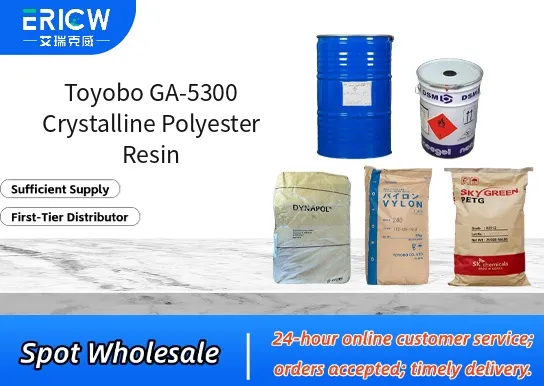
Highly crystalline structure enabling rapid melt crystallization and excellent storage stability.
Low melt viscosity at processing temperatures, facilitating smooth extrusion and uniform film formation.
Outstanding thermal stability with minimal degradation up to 240 °C under inert atmosphere.
Excellent compatibility with aliphatic polyesters and biodegradable polymer blends.
Consistent batch-to-batch reproducibility meeting ISO 9001-certified manufacturing standards.
Biaxially oriented polyester (BOPE) films for high-barrier flexible packaging.
Heat-sealable top layers in multilayer food packaging laminates.
Crystallinity-enhancing modifier in PLA/PBAT-based compostable films.
Base resin for engineered monofilaments requiring dimensional stability and stiffness.
Carrier resin in masterbatch formulations for color and additive dispersion.
| Chemical Type | Copolyester (terephthalic acid / adipic acid / ethylene glycol) |
| Product Form | Pellets (cylindrical, ~3 mm diameter × 2.5 mm length) |
| Appearance | Opaque white to off-white granules |
| Melt Point (DSC, 10 °C/min) | 225–232 °C |
| Crystallinity (XRD) | ≥45% (by weight) |
| Intrinsic Viscosity (IV, 0.5 g/dL in phenol/chloroform) | 0.62–0.68 dL/g |
| Moisture Content (ASTM D6869) | ≤0.05 wt% |
| Primary Applications | High-crystallinity film & fiber applications requiring thermal and dimensional stability |
Q1: What is the primary functional role of GA-5300 in powder coating formulations?
A: GA-5300 serves as a crystalline polyester resin component that enhances flow control, improves film uniformity, and contributes to rapid curing behavior—particularly in low-temperature or accelerated cure systems. Its crystallinity supports improved storage stability and reduced blocking tendency in formulated powders.
Q2: How does GA-5300 differ from conventional amorphous polyesters used in thermosetting powder coatings?
A: Unlike amorphous polyesters, GA-5300 exhibits well-defined crystallinity, resulting in sharper melting behavior, lower melt viscosity at processing temperatures, and improved compatibility with specific crosslinkers such as TGIC or hydroxyalkyl amide (HAA) systems. This enables more precise rheology tuning during extrusion and film formation.
Q3: Is GA-5300 suitable for use in food-contact compliant powder coatings?
A: GA-5300 is designed for high-performance industrial coatings and may be incorporated into food-contact formulations where permitted by applicable regulatory frameworks—but final compliance depends on the complete formulation, curing conditions, and end-use requirements. Toyobo recommends full regulatory evaluation by the coating formulator.
Q4: What are typical handling and storage recommendations for GA-5300?
A: Store in a cool, dry environment below 30 °C, away from direct sunlight and moisture. Due to its crystalline nature, avoid prolonged exposure to elevated ambient temperatures that may induce partial sintering or agglomeration. Keep containers sealed when not in use to maintain optimal flow and processing characteristics.
Q5: Can GA-5300 be blended with other polyester resins or acrylics in hybrid systems?
A: Yes—GA-5300 demonstrates good compatibility with selected amorphous polyesters and certain acrylic resins in hybrid powder coating systems. However, compatibility and phase behavior should be verified experimentally, as performance outcomes depend on molecular interactions, thermal profiles, and crosslinker selection.
Contact With Us:
E-mail: wangxingqiang@ericwchem.com
Have a Questions? Call Us:
Add:
Building A1, Jiete Industrial Park, Huangpu District, Guangzhou City, Guangdong Province, China