English
 Español
 tiếng việt
 русский
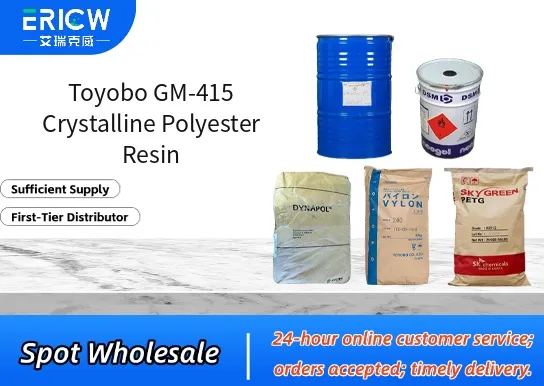
Highly crystalline structure enabling rapid melt crystallization and excellent powder flowability.
Outstanding thermal stability with minimal degradation during extrusion and melt processing.
Consistent particle size distribution for uniform melting behavior in powder coating applications.
Low melt viscosity at processing temperatures, facilitating smooth film formation and edge coverage.
Excellent chemical resistance to solvents, weak acids, and alkalis after curing.
Thermosetting powder coatings for architectural aluminum extrusions.
Functional coatings on metal furniture and office equipment.
Protective finishes for outdoor electrical enclosures and utility boxes.
Decorative and durable coatings for automotive trim components.
Industrial coil coating primers requiring high crystallinity and fast cure response.
| Chemical Type | Copolyester (crystalline, carboxyl-terminated) |
| Product Form | Pale yellow to off-white granules |
| Appearance | Free-flowing crystalline solid |
| Melting Point (DSC, 10°C/min) | 185–192°C |
| Acid Value | 28–32 mg KOH/g |
| Number Average Molecular Weight (Mn) | ~3,500–4,200 g/mol |
| Crystallinity (DSC) | ≥75% (by enthalpy of fusion) |
| Primary Applications | Standard polyester-based thermoset powder coatings (TGIC-free systems) |
Q1: What is the primary functional role of GM-415 in powder coating formulations?
A: GM-415 serves as a crystalline polyester resin designed to act as a flow and leveling agent, enhancing melt rheology and promoting uniform film formation during curing—particularly beneficial in low-cure or thin-film applications.
Q2: How does GM-415 differ from amorphous polyesters commonly used in powder coatings?
A: Unlike amorphous polyesters, GM-415 exhibits a defined crystalline structure, resulting in sharper melting behavior, improved storage stability in blended formulations, and reduced tendency toward premature agglomeration during storage.
Q3: Is GM-415 compatible with standard epoxy-based crosslinkers used in hybrid powder coatings?
A: Yes, GM-415 demonstrates good compatibility with conventional glycidyl-functional epoxy resins and triglycidyl isocyanurate (TGIC), enabling its use in both pure polyester and hybrid (polyester-epoxy) systems without significant phase separation or gelling issues.
Q4: What handling precautions should be observed when incorporating GM-415 into powder coating blends?
A: Due to its crystalline nature and relatively low softening point, GM-415 should be added during the extrusion stage at controlled temperatures to avoid premature melting or uneven dispersion; pre-blending with carrier resins prior to extrusion is recommended for optimal homogeneity.
Contact With Us:
E-mail: wangxingqiang@ericwchem.com
Have a Questions? Call Us:
Add:
Building A1, Jiete Industrial Park, Huangpu District, Guangzhou City, Guangdong Province, China