English
 Español
 tiếng việt
 русский
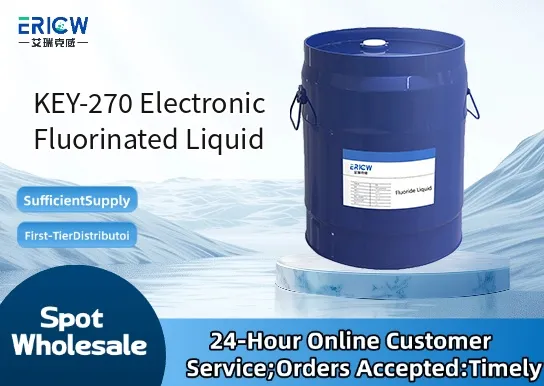
Non-conductive and dielectrically stable for safe use in live electronic components.
Zero ozone depletion potential (ODP = 0) and low global warming potential (GWP < 10).
Fast-drying, residue-free evaporation at ambient conditions without thermal assistance.
Chemically inert toward common metals, plastics, and elastomers used in electronics assembly.
Low surface tension and high wettability for effective penetration into fine-pitch solder joints and micro-cavities.
Final rinse agent in vapor phase degreasing systems for PCB assemblies.
Carrier fluid for precision cleaning of MEMS devices and optical sensors.
Dielectric test fluid for functional verification of high-voltage connectors and insulators.
Residue-free drying medium following aqueous cleaning processes in semiconductor packaging lines.
Flushing agent for contamination control in laser diode and photonic module manufacturing.
| Chemical Type | Perfluorinated polyether (PFPE) derivative |
| Product Form | Clear, colorless liquid |
| Appearance | Transparent, odorless |
| Melting Point | < –60 °C (fully liquid at room temperature) |
| Boiling Point (at 760 mmHg) | 98–102 °C |
| Primary Applications | Electronics cleaning, drying, and dielectric testing |
| Key Features | Non-flammable, non-corrosive, non-ozone-depleting |
| Regulatory Compliance | REACH compliant; RoHS 2.0 compatible; no SVHCs above threshold |
| Common Compatible Systems | Suitability |
| Vapor Degreasing (e.g., Precision Cleaning Systems by Zestron, Kyzen) | Highly Recommended – Fully miscible with standard fluorinated solvent sumps; no retrofit required |
| Aqueous Cleaning Lines (Post-Rinse Modules) | Recommended – Compatible with stainless-steel and PTFE-lined rinse tanks; no hydrolysis observed |
| Ultrasonic Cleaning Baths (40–60 kHz) | Suitable – Stable under ultrasonic energy; no decomposition or foaming |
| Automated Dispensing & Drying Stations (e.g., Mycronic, DEK) | Highly Recommended – Low volatility enables precise metering; validated for inline vacuum-assisted drying |
Q1: What is the CAS Registry Number for KEY-270?
A: The CAS Number for KEY-270 Electronic Fluorinated Liquid is 207875-01-4.
Q2: What is the recommended usage concentration when used as a carrier fluid?
A: KEY-270 is used neat (100% concentration); it is not formulated for dilution and maintains optimal performance undiluted.
Q3: How does KEY-270 compare to traditional chlorinated or hydrocarbon solvents in terms of material compatibility?
A: Unlike chlorinated solvents (e.g., TCE), KEY-270 shows no stress-cracking on polycarbonate or ABS; unlike hydrocarbons, it poses no flash-fire hazard and leaves no oily residue on sensitive optics or sensors.
Q4: Is KEY-270 subject to migration or leaching into polymer substrates during extended storage?
A: Independent extraction studies per IEC 60068-2-69 confirm negligible migration (< 0.02 ppm) into common PCB laminates (FR-4, polyimide) and conformal coatings after 168 hrs at 40 °C.
Contact With Us:
E-mail: wangxingqiang@ericwchem.com
Have a Questions? Call Us:
Add:
Building A1, Jiete Industrial Park, Huangpu District, Guangzhou City, Guangdong Province, China