English
 Español
 tiếng việt
 русский
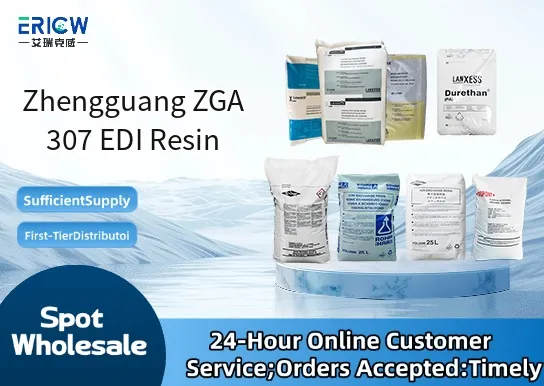
Highly uniform spherical bead morphology ensures stable hydraulic performance and low pressure drop in EDI modules.
Optimized anion/cation exchange capacity ratio for balanced ion removal and extended operational cycle life.
Low soluble organic extractables (SOE) meeting stringent semiconductor-grade ultrapure water requirements.
Excellent chemical stability in continuous electrochemical regeneration environments, resistant to oxidation and hydrolysis.
Pre-packed and pre-conditioned for direct use—minimizes system startup time and reduces commissioning risk.
Ultrapure water production for semiconductor manufacturing facilities.
Pharmaceutical-grade water systems compliant with USP <841> and EP 2.6.1 standards.
Power plant boiler feedwater polishing in combined RO-EDI configurations.
Research laboratory water purification systems requiring >18.2 MΩ·cm resistivity.
Electronics manufacturing process rinse water recycling and reuse circuits.
| Chemical Type | Mixed-bed ion exchange resin (strong acid cation / strong base anion) |
| Product Form | Pre-mixed, pre-packed, hydrated beads |
| Appearance | Uniform spherical beads, off-white to light amber color |
| Primary Applications | Electrodeionization (EDI) for ultrapure water generation |
| Key Features | Low TOC leaching, high packing density, narrow particle size distribution |
| Storage Conditions | 5–35 °C, protected from freezing and direct sunlight |
| Shelf Life | 24 months from date of manufacture when stored properly |
| Regulatory Compliance | Meets NSF/ANSI Standard 61 for drinking water system components (optional certification available) |
Q1: What is the primary function of Zhengguang ZGA 307 EDI Resin in ultrapure water systems?
A: Zhengguang ZGA 307 EDI Resin is a mixed-bed ion exchange resin specifically engineered for use in electrodeionization (EDI) modules. It facilitates continuous deionization of pretreated feed water by removing residual ions through electrochemical regeneration, enabling stable production of ultrapure water without chemical regeneration cycles.
Q2: Is ZGA 307 compatible with standard commercial EDI stacks?
A: Yes, ZGA 307 is designed to meet industry-standard physical and hydraulic specifications for EDI resin fill, including particle size distribution, uniformity coefficient, and moisture retention. It is suitable for integration into common modular EDI systems, though optimal performance requires verification of operating parameters such as current density, flow rate, and feed water quality.
Q3: How does ZGA 307 differ from conventional mixed-bed resins used in polishing tanks?
A: Unlike batch-type mixed-bed resins, ZGA 307 features enhanced electrochemical stability, low electrical resistance, and optimized ionic form conversion kinetics—enabling efficient in-situ regeneration under DC current. Its matrix structure supports sustained performance in continuous-flow EDI operation, where long-term fouling resistance and minimal pressure drop are critical.
Q4: What feed water quality is recommended for optimal ZGA 307 performance?
A: ZGA 307 performs best when fed with reverse osmosis (RO) permeate meeting typical EDI inlet specifications: conductivity ≤ 20 µS/cm, total organic carbon (TOC) < 0.5 ppm, and silica < 0.5 ppm. Effective pretreatment—including RO, activated carbon filtration, and particulate removal—is essential to prevent premature resin fouling or scaling.
Contact With Us:
E-mail: wangxingqiang@ericwchem.com
Have a Questions? Call Us:
Add:
Building A1, Jiete Industrial Park, Huangpu District, Guangzhou City, Guangdong Province, China