English
 Español
 tiếng việt
 русский
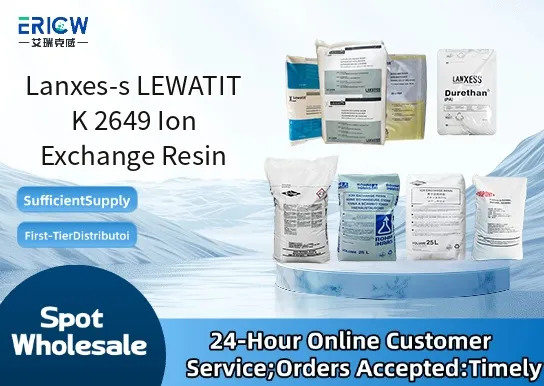
Highly selective for potassium (K⁺) and ammonium (NH₄⁺) ions in complex aqueous matrices.
Stable polyacrylic matrix ensures excellent mechanical strength and resistance to osmotic shock.
Low operating pressure drop enables efficient use in packed-bed and continuous ion exchange systems.
Optimized particle size distribution (0.3–1.2 mm) supports uniform flow dynamics and reduced channeling.
Regenerable with common eluents such as NaCl or KCl, supporting sustainable process cycles.
Ammonium removal from municipal and industrial wastewater prior to discharge or reuse.
Potassium recovery and concentration in fertilizer production and nutrient recycling streams.
Polishing step in pharmaceutical water systems requiring low-level ionic impurity control.
Pre-treatment for reverse osmosis feedwater to mitigate scaling by selective cation removal.
Specialty separation in food & beverage processing where sodium-free potassium adjustment is critical.
| Chemical Type | Polyacrylic acid-based weakly acidic cation exchanger |
| Product Form | Moist, spherical beads |
| Appearance | Opaque white to light yellow beads |
| Functional Group | Carboxylic acid (–CH₂COOH) |
| Ion Form | Hydrogen form (H⁺), ready for conversion |
| Particle Size Range | 0.3 – 1.2 mm |
| Moisture Content | ~45 – 50 % (w/w) |
| Temperature Limit | Max. 100 °C (short-term), 80 °C (continuous) |
Q1: What is the primary functional group and ionic form of LEWATIT K 2649?
A: LEWATIT K 2649 is a strongly basic anion exchange resin with quaternary ammonium functional groups, supplied in the chloride (Cl⁻) ionic form.
Q2: Is LEWATIT K 2649 suitable for use in pharmaceutical or food-grade water purification systems?
A: Yes — it is designed for high-purity applications including deionization of process water in pharmaceutical and food & beverage industries, provided it is properly regenerated and validated per system requirements.
Q3: How does LEWATIT K 2649 differ from standard gel-type strong base anion resins?
A: It features a macroporous polyacrylate matrix offering enhanced kinetic performance, superior resistance to organic fouling, and improved stability under varying pH and temperature conditions compared to conventional gel-type resins.
Q4: What regeneration chemicals are recommended for LEWATIT K 2649?
A: Sodium hydroxide (NaOH) is the standard regenerant; concentration and contact time should be optimized based on feed water quality and operational objectives, typically within common industrial ion exchange practice.
Contact With Us:
E-mail: wangxingqiang@ericwchem.com
Have a Questions? Call Us:
Add:
Building A1, Jiete Industrial Park, Huangpu District, Guangzhou City, Guangdong Province, China