English
 Español
 tiếng việt
 русский
Excellent balance of thermoplastic processability and elastomeric resilience
High tensile strength and outstanding elongation recovery at elevated temperatures
Good resistance to oils, greases, and common industrial solvents
Low compression set for durable sealing and dynamic component performance
Enhanced melt stability for consistent extrusion and injection molding
Automotive fluid handling components (e.g., fuel lines, coolant hoses)
Industrial drive belts and timing belt covers
High-performance sporting goods parts (e.g., ski bindings, bicycle suspension bushings)
Electrical cable jacketing requiring flexibility and environmental resistance
Consumer appliance seals and gaskets exposed to thermal cycling
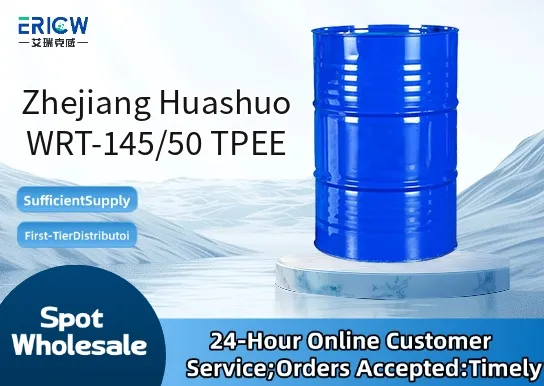
| Chemical Type | Thermoplastic Polyester Elastomer (TPEE) |
| Product Form | Pellets |
| Appearance | Off-white to light beige granules |
| Hardness (Shore D, ASTM D2240) | 50 ± 2 |
| Melt Flow Rate (230°C/2.16 kg, ASTM D1238) | 25–35 g/10 min |
| Density (ASTM D792) | 1.18–1.22 g/cm³ |
| Key Features | High elasticity retention, thermal stability up to 145°C continuous service |
| Primary Applications | Dynamic mechanical parts requiring fatigue resistance and dimensional stability |
Q1: What is the primary functional role of WRT-145/50 in thermoplastic elastomer formulations?
A: WRT-145/50 is a polyether-based thermoplastic elastomer (TPEE) designed to provide balanced mechanical strength, elasticity, and melt-processability. It serves as the continuous matrix phase in TPEE blends, contributing resilience, fatigue resistance, and dimensional stability under dynamic loading conditions.
Q2: Is WRT-145/50 suitable for applications requiring repeated flexing or cyclic deformation?
A: Yes — its inherent polyether soft segment architecture delivers excellent recovery performance and long-term flex life, making it well-suited for components such as automotive bellows, power tool grips, and sporting goods parts subject to frequent bending or torsion.
Q3: How does WRT-145/50 compare to polyester-based TPEEs in terms of hydrolytic stability?
A: Due to its ether linkages, WRT-145/50 exhibits significantly improved resistance to hydrolysis compared to conventional polyester-type TPEEs — especially under warm, humid, or mildly acidic/alkaline conditions — which supports extended service life in demanding outdoor or industrial environments.
Q4: Can WRT-145/50 be processed using standard thermoplastic equipment?
A: Yes — it is fully compatible with common melt-processing methods including injection molding, extrusion, and blow molding. Drying prior to processing is recommended to maintain optimal mechanical properties, and typical melt temperatures fall within the range suitable for conventional TPEE-grade machinery.
Q5: What types of additives or modifiers are commonly used with WRT-145/50 to enhance performance?
A: Standard stabilizers (e.g., hindered phenols and phosphites), UV absorbers, and processing aids are frequently incorporated. Reinforcing fillers like glass fibers or mineral fillers may be added to improve stiffness and heat deflection temperature, while compatibilizers are sometimes employed in multi-polymer blends to ensure interfacial adhesion.
Contact With Us:
E-mail: wangxingqiang@ericwchem.com
Have a Questions? Call Us:
Add:
Building A1, Jiete Industrial Park, Huangpu District, Guangzhou City, Guangdong Province, China