English
 Español
 tiếng việt
 русский
Excellent melt processability via injection molding and extrusion with low energy consumption.
Superior soft-touch feel and high elasticity, maintaining shape recovery after repeated deformation.
Good compatibility with polypropylene (PP) and polyethylene (PE), enabling robust overmolding adhesion.
Halogen-free formulation meeting RoHS and REACH compliance requirements for regulated markets.
Enhanced UV resistance and thermal stability up to 120 °C for extended service life in demanding environments.
Soft-grip overmolded handles for power tools and garden equipment.
Sealing rings and gaskets in automotive fluid systems.
Flexible hinges and snap-fit components in consumer electronics enclosures.
Medical device grips and non-slip surfaces requiring biocompatibility support (ISO 10993 pre-screened).
Food-contact–approved components for kitchen appliance seals and lids (FDA-compliant compound variant available).
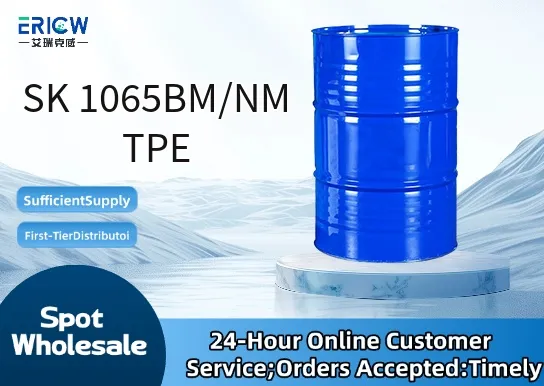
| Chemical Type | Thermoplastic Elastomer (TPE), Styrenic Block Copolymer (SBC)-based |
| Product Form | Natural color pellets, free-flowing, uniform size |
| Appearance | Opaque off-white to light beige granules |
| Primary Applications | Overmolding, soft-touch components, dynamic seals |
| Key Features | PP/PE adhesion, halogen-free, low compression set |
| Benefits | Reduced cycle time, recyclable processing scrap, no vulcanization required |
| Density (g/cm³) | 0.91–0.93 (ASTM D792) |
| Melt Flow Rate (g/10 min, 200 °C/5 kg) | 25–35 (ASTM D1238) |
Q1: What is the primary functional role of SK 1065BM/NM TPE in thermoplastic elastomer formulations?
A: SK 1065BM/NM TPE is a specialty processing aid and compatibilizer designed to enhance melt flow, reduce viscosity, and improve dispersion of fillers or polar additives in TPE blends—particularly in SEBS- and TPO-based systems.
Q2: Is SK 1065BM/NM TPE compatible with common TPE base polymers such as SEBS, TPU, and PP/EPDM blends?
A: Yes—it demonstrates broad compatibility across major TPE platforms, including styrenic block copolymers (SEBS/SBS), thermoplastic polyurethanes (TPU), and polyolefin-based elastomers (TPO), supporting homogeneous blending without phase separation under standard processing conditions.
Q3: How does SK 1065BM/NM TPE affect surface appearance and gloss in finished TPE parts?
A: It typically contributes to improved surface smoothness and consistent gloss by promoting uniform polymer flow and reducing melt fracture—especially beneficial for thin-walled or highly aesthetic applications requiring defect-free finishes.
Q4: What processing advantages does SK 1065BM/NM TPE offer during extrusion or injection molding?
A: Users commonly report reduced torque demand, lower barrel temperatures, shorter cycle times, and improved dimensional stability—attributed to its ability to lower melt viscosity and enhance thermal homogeneity without compromising mechanical integrity.
Contact With Us:
E-mail: wangxingqiang@ericwchem.com
Have a Questions? Call Us:
Add:
Building A1, Jiete Industrial Park, Huangpu District, Guangzhou City, Guangdong Province, China